
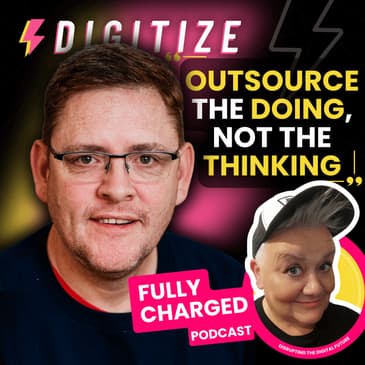
Welcome to the Digitize Fully Charged Podcast, where we energise listeners, spark inspiration, and top-up your tech-game. In this episode of the Digitize Fully Charged Podcast, hosts Niall and Pam sit down with their good friend and award-winning educator, Daren White! If you’re passionate about the intersection of tech and teaching, Daren is a name you need on your radar. With over 25 years in the classroom and 15+ years in senior leadership, he currently supports as the Academic Technologies Lead for a prominent UK Multi-Academy Trust. Daren has dedicated his career to a clear mission: blending sound pedagogy seamlessly with technology to remove learning barriers for every student. As a certified Canva Trainer and Google Champion, Daren travels the UK and international stage delivering energetic keynotes, practical workshops, and high-impact coaching. His contributions to digital innovation in education have earned major industry recognition—including a spot on the 2021 #EdTech50 list, the Skills Development Champion Award at the 2023 Edufuturists Awards, and a Silver Award for Digital Innovator of the Year at the 2023 National Teaching Awards. On top of all that, he’s the author of the hit book, What’s Their Why?: Exploring Motivation and Engagement in Learning. Hit play to hear Daren, Niall, and Pam dive deep into practical EdTech strategies and the future of digital learning!
Chapters 📚
00:00 – Welcome to the Digitize Fully Charged podcast
00:43 – Meet Patrick Hickey: Surviving a 107,000-Word PhD
03:55 – Lived Experience: Prosthetics and Teacher Identity
05:14 – Overcoming Invisible Disability Challenges in Schools
07:24 – Psychological Tricks to Finish the Journey
10:18 – Confessions of a Former "Non-Techy" Teacher
12:07 – The Golden Rule: Don't Use Tech for Tech's Sake
13:38 – Pandemic Pivot to the Google Inclusive Trainer Journey
16:44 – True Inclusion: Making Difference Completely Invisible
18:17 – The Stigma of Separate Assistive Technology Budgets
21:35 – How AI Reinvigorated Educational Technology
22:20 – Debunking the Myth of "Digital Natives"
24:12 – Personalising Learning and Cutting Planning Time
27:14 – Minimising Clicks: The Zero Learning Curve of AI
29:09 – Building Community at the Google Champion Symposium
30:30 – The Reality of Irish Teacher Career Breaks
33:13 – Driving and Thriving with Notebook LM
35:22 – Bypassing Traditional Search for AI Conversations
40:10 – Ditching 19th-Century Exams for 21st-Century Problems
Got a question for us? Drop us a message, or check out our dedicated podcast website at https://digitize-fully-charged.podcastpage.io/
We’re so excited to introduce you to our world via the Digitize Fully Charged Podcast. Each week, we’ll bring you top-tier guests, curate new and exciting tools for you to try, and answer your tech-fuelled questions so that you leave feeling fully charged and ready for action.
Subscribe and turn on notifications for the show, and, if you'd like to stay up to date with shows and more, follow us on social media @DigitizeCrew and check out the wearedigitize.com website.
Daren White: Instagram, LinkedIn, rangaedu.com, Daren’s Book - What’s Their Why?
Digitize: Website, Podcast page, Instagram, Facebook, X, TikTok, LinkedIn, YouTube
Podcasts: Spotify, Apple Podcasts, YouTube, Amazon Podcasts, Deezer
Hosted on Acast. See acast.com/privacy for more information.
[00:00:29] Welcome to another episode of the Digitize Fully Charged Podcast. My name's Pam Curry, I'm joined as always by my co-host Niall Ridgeway. Today's episode is a brilliant chat with Daren White. He's an award-winning innovator, educator. He's got his own book called What's There Why? And without further ado, let's just dive into the episode with Daren White.
[00:00:57] I'm super excited. We've had a lot of silliness in the run-up to this, press and record on this. But I'm super excited to introduce today's guest is Daren White from Ranga EDU and he's going to tell us why it's called Ranga EDU. Daren, could you just introduce yourself to our audience, please? Yeah, sure. Great to be here. Thanks for having me.
[00:01:22] So I'm Daren. The Ranga EDU comes from my nickname, actually, from my sporting... I was going to say prowess then, but that would be wild. That's how we blow up an exaggeration. Yeah, we need to start with something mildly believable, otherwise enough people will listen to the rest of it, right? So it comes from my nickname, the Red and Nearly Ginger Association. It's a proud ginge. That's kind of where it came from.
[00:01:51] I was like, let's go with that. Yeah, I mean, in Scotland, we have a lot of those Red and Nearly Ginger people. So, Daren, one of the things I noticed in your show notes for this is that you used to share an office with Dean Stokes. But more than that, you used to teach him? Tell us about Dean.
[00:02:19] Yeah, Dean was in my first ever class when I started teaching as an NQT back in 1999, I think it was. He was in year seven and he was in my French class. And, yeah, taught him for a few years. Ended up working together when he started doing some volunteer work when he was in the sixth form at the school that we were both at at the time. And then things moved on from there and eventually became a colleague and a really good friend.
[00:02:48] Yeah, I owe Dean a huge amount. I've learned loads from him. And if you ever listen to his French, you'll know he's learned very little from me. And I'm sure he'd be the first to admit that. Question is, though, has he taken you on a roller coaster with him? Do you have a part of that? No, I followed that journey. It was brilliant. And I was on holiday at the time.
[00:03:16] So I was joining as often as I could on TikTok and all that kind of thing. Absolutely, hats off to him. Amazing. Personally, I hate roller coasters. Same. But also, I'm too tall to get on a lot of them. Stick to the T-cups. I think I remember your tallness because I'm very short. And I think I remember sort of walking beside you in London at one point looking up to you. Obviously, metaphorically and literally. Absolutely. I often look down on people.
[00:03:46] Literally. Only physically. Absolutely, yeah. Yeah, Dean and I go way back. He's a great guy. Don't see as much of him as I'd like these days. But we used to do a lot of regular escape rooms and things like that, which is obviously where he's thrill-seeking. Comes in. And yeah, we had great fun. You just wonder what he's going to get up to next, eh? Sky's the limit, isn't it? What is he going to do next?
[00:04:14] If anyone of our listeners is currently listening to this thinking, who is this Dean Stokes guy? Check him out on YouTube. He's got his own YouTube channel now. And he's been on the podcast way back. So just have a look down our podcast list and you'll find out more about Dean. Yeah, absolutely. But I love that. They used to teach him. You got any little nuggets for us about what he was like as a pupil? Or was he keen and swatty?
[00:04:43] He was, yeah, he'd be the first to admit it. He was actually really quiet and shy as a kid. Yeah. Which you wouldn't think. I know he told us that, didn't he, on the pod. He was like, yeah, I was really quiet as a pupil. So what have you been up to then, Darren? What have you been up to in the last wee while? I mean, I've been incredibly busy. My day job as academic technologies lead with Lyft Schools.
[00:05:12] We're one of the largest trusts in England. So we've got 57 schools currently. And I mean, you know, I lead on the academic use of technology. A large part of that obviously now includes the use of AI. So I've been doing a lot of work visiting all of our schools, delivering training for staff, strategic work in the background as well. But then also as part of our kind of system generosity piece,
[00:05:40] going out and supporting other trusts and other schools in providing training and things like that as well. So, yeah, it's kept me very busy. Lots of miles under the belt. Oh, yeah. But brilliant because it means I get to see so many different contexts. I get to see loads of different schools. I get to speak to loads of different people, sharing their experiences and really use that to support other schools, but also to support our schools at the same time.
[00:06:08] And form your practice, I was going to say. Yeah, just like it. Yeah. And I'm really fortunate as well to be part of the Digital Futures group with some cracking individuals, Emma Darcy and Gary Henderson and Avid and Gemma and, you know, James Garnett and Johnny Wathen. So we're really fortunate that we've got our own little kind of hotbed of friendly challenge, I would say.
[00:06:35] You know, there's plenty of banter, but there's good, healthy challenge to ideas, mix of different users of different platforms, different perspectives, private, independent, per state. It's really good to be able to kind of just have those open and honest conversations and shoot the breeze over things that, you know, particularly with AI, where we're all building the plane while we're flying it, right? Mm-hmm. Totally. Absolutely. Totally. We're still learning. And what is the kind of feeling?
[00:07:04] So I've delivered a few AI workshops now. Most of them are actually not with education, but with businesses. Or businesses. But, like, I've honestly, like, I don't know if this is a sort of reflection of my skills as a trainer, but, like, I've never been applauded out of a room before, ever, right? But when I recently delivered an AI workshop, I got applauded out of the room and it was nothing to do with me. It was absolutely nothing to do with me.
[00:07:33] It was to do with what AI had shown them and its potential. And actually, I think for me it's, like, become the easiest gig ever is to deliver people an AI session because it kind of, like, you get the wow moments built in really easily, don't you? And it's personalized as well directly to them. Yeah. Yeah. So how's that been for you? Like, what have you noticed in that? Yeah, I mean, I often get people to applaud when I leave the room.
[00:08:01] So usually it's the wife, you know. Brilliant. No, I completely agree. Like you say, though, it's because you are able to personalize it to what really does, you know, answer genuine challenges for people. And, you know, it's not always immediate, but actually just, you know,
[00:08:29] one of the things I like about AI, and I've said this previously, I think on other podcasts, because I was a modern language teacher. Around about 2006, Google Translate really started to arrive in style and I suddenly realized that, you know, there are my year sevens that I'd been teaching since, you know, the 3rd of September. It was the 10th of September and they were producing A-level work. You know? And I was like, hold on a minute. I didn't teach you these words.
[00:08:58] I definitely wouldn't teach you some of those words. Certainly not your age. Yeah. And in amongst, like, it was funny, but it was a real challenge, right? Because you had some really good use of that tool that pupils would, and applaud them, like, were being resourceful. Yeah. They didn't have access to a bilingual dictionary at home, but they had access to this, so they were using it. And some of what they pulled through was brilliant and some of it was rubbish. And I very quickly realized what I needed to do
[00:09:27] was to kind of get my teeth into it myself so that I could understand what worked and what didn't and then advise them on the best responsible approaches to using a tool that was readily available. And I think that stood me really in good stead for, you know, AI. That was, you know, it's all part and parcel of the same thing anyway, but really embracing that. And now trying to get people to embrace the fact that, you know,
[00:09:57] AI is not one thing, right? There's loads of loads of different parts of it, and it's going to, different tools are going to be right for the right things. And it's like, you know, good friend Gemma always says, you know, the right tool for the right outcome at the right time for the right people. And actually, for one person, one particular tool might be ideal, and you might not see a benefit of it from another perspective for ages. You know, I was exactly on that kind of,
[00:10:27] exactly in that situation with something like Google Vids. I saw it when we were in Dublin, actually, at the Champions Symposium. I saw it and thought, okay, that's quite cool. But I couldn't really find a use for it for me at that time. Sure. And it was only about three weeks ago. Somebody said to me, we really need to update these videos we've got. And I was like, oh, we might have an option here. Have we got the slides that we used in that first recording?
[00:10:54] And instead of re-recording and it taking like 50 minutes to re-record those videos, there's the speaker notes, generate the voice. Amazing. And actually, it's all done and dusted in about six minutes. And that was super powerful because apart from it being faster, it took away the anxiety from that colleague who really didn't want to do the recording because they've got, you know. No, he didn't want to stand in front of the camera. No, exactly. And you know what?
[00:11:22] Unlike me, people don't like listening to their own voice. That's good to know you'll listen back to this podcast then. This episode will be, we'll have one viewer. So seeing your trust, what's your tech stack then? What are the schools using? So we are predominantly Google across the board. So we're Google users and also Canva.
[00:11:50] So from a pupil-facing perspective, Google Workspace and Canva are kind of like the go-to things that everybody is using. And obviously, we've got our MIS and things like that in the background. But principally, yeah, it's Google and Canva are our main stack with a few other bits and pieces here and there. And you've got one-to-one? It varies across the schools. So some of our schools are one-to-one in person. So the pupils have their own device and take them home with them.
[00:12:17] In some places, they're one-to-one, but they leave them at school and charge overnight. In some cases, it's nominally one-to-one because there's enough, but they are used within departments and things like that rather than the pupils actually take them home. But yeah, effectively, every pupil can have access to a device at every point in the day if they need to. And if it's going to have a positive impact on learning, using the right tools at the right time.
[00:12:44] What's the deal with AI then in terms of Gemini? Are you Gemini? Rolling out Gemini as a training focus on Gemini? Yeah, so I've run, as I said, a series of trainings with staff just around AI in general. And this year, we're doing more around Gemini Academy. So I'm delivering Gemini Academy. Actually, we had our trust digital and data conference just last week. And we had about 90 attendees from across the trust there.
[00:13:13] And as part of that, I delivered Gemini Academy. So we've got about 40 graduates from that that can then go off back to their schools, delivering schools, help to obviously deliver the pupil version as well. But Gemini, yeah, has been really impressed with the moves that have been made within that. And alongside that, the shareability of things like GEMS, Notebook LM being available to pupils as well.
[00:13:42] So, you know, that Learn LM background, I think, is really powerful. And what about the kind of, like, so, I mean, there's a lot of debate happening online just now, especially in the edtech community, I guess, about GDPR, data protection, uploading things to AIs. And, you know, Google, as usual, as per Google's approach to most of the workspace tools,
[00:14:08] really clear stance on GDPR in terms of Gemini. How's that gone down in the kind of school community? And, you know, what's the powerful, the important message for everyone around that? Because, you know, we're still catching up policy-wise, aren't we? Like, as you said, we're flying the plane as we're building it. Yeah, absolutely. Yeah. I think generally people have been really encouraged by what they've seen from Gemini and Canva as well
[00:14:38] in terms of the built-in community standards, the safeguards that are in the system itself, and also the data protection, the fact that, you know, real clarity alongside the DFE standards and expectations around safeguarding and safety measures in that that data isn't being used to train the model. Train the models. It's not being reviewed by humans. It's not being sold on to third parties.
[00:15:04] It's all effectively staying within your tenancy, so you're maintaining control of it. I think that's been really positive. Yeah. And, you know, it's been good. It's been a good conversation to have because people have concerns for the right reasons, and I think those conversations are really important. And if we stop having those conversations, you know, that's the risk for me because then people become complacent and do the kind of, oh, we thought it was all all right.
[00:15:31] But actually, I love it when people challenge me and say, is this safe? Or what are the safeguards around this? So I think it's a really healthy conversation. It is because you're like, well, one of my previous lessons, workshops, must have hit home a wee bit. Yeah, absolutely. Yeah. I was going to say, within the trust, we have an AI network, so we meet regularly, and it's a mix of roles from across the trust. And we've done things like we've all had pupil access early,
[00:16:01] so we've had pupil access accounts, so we can go in, we can see what the pupil experience is like and really test it. And the feedback from that network has been really positive in terms of what we weren't able to do, which was encouraging and comforting as well. So you're really pushing those limits and typing in things that potentially might cause a bit of difficulty for our students and seeing just kind of what gets through, what doesn't. Yeah, and being really creative about that.
[00:16:30] So not necessarily just being upfront and straight out with it, but also being really nuanced, using things like emojis and slang and all those kind of things, just to see whether you can, or if you're really nice and you just say, oh, go on, just really try and help me, will you? Yeah. So really trying to jailbreak that side of things. Yeah, because it was a whole thing, maybe about a year ago now or longer,
[00:16:53] where people were saying, oh, I'm this 150-year-old who's never used technology before. Can you explain to me how XYZ works? And bypassing a lot of the safety things that were put in place for these LLMs. And so I'm glad to hear that from the education side of things, A, you've tested it, but also that these safeguards are in place and it is very hard to kind of get past those.
[00:17:22] Yeah, and we've obviously got our monitoring and our filtering software working over and above that as well. So there's a second layer as well that, you know, even if something were to get through, it would still get picked up and it would still be alerted. The DSL is alerted, you know, our admins are alerted and everything else. So, yeah, it's been really encouraging. That's great. And we're not going to teach responsible use if pupils don't get some exposure to them. Definitely. Yeah, I mean, we've still got some local authorities in Scotland
[00:17:50] that block YouTube for everyone. Yeah. Teachers as well. Like, it's bizarre. And do you know what? That's a really good example. I can understand the thought behind it because when you look at YouTube in its raw form, there's all sorts of comments and links and things posted elsewhere. But if people don't understand that, you don't have to give them that unfettered view of YouTube. You can show them the video without everything else around it and then it's much safer.
[00:18:20] And a lot of people don't understand that. So they go down to gut reaction of, well, let's just make sure it's not available at all then. And that's about having the right conversations with the right people, isn't it? Yeah, totally. I heard you mention in there as well about Gemini Academy. Is that somewhere like a good starting place for people to learn how to use AIs? Is that a free resource? Do they have to pay for a trainer to come and help them? Can you give us a wee bit of insight into that? Yeah. So it's something that was offered to all of us who are Google champions,
[00:18:49] from the trainer community, everything else. So I went through the kind of the train, the trainer process with Andy Caffrey from Canopy. So I'm now able to deliver Gemini Academy to others, as are a couple of other people within the trust. And we've taken advantage of that to be able to say, look, this is just a couple of hours of your time, but that time invested in learning, A, what it's doing, but also B, how to get the best out of it.
[00:19:19] You are going to make that time back in no time at all. And even today, you know, I've had a message from a colleague who was at the conference on Friday, who said, I've used Notebook LM in this case today. And I think in this single use, it saved me three hours of work. Amazing. And more importantly as well, actually, I should have said on that, it's not just it saved her three hours of work. What she also said was, she's probably picked up on,
[00:19:49] or through using Notebook LM, it's picked up some things that she may not have picked up on. Oh, brilliant. So it's just made her think, you know, and we talk a lot, and I talk a lot about making sure that we outsource the doing and not the thinking. And actually the doing bit can really empower us to spend more time doing the thinking. The thinking. And to dive into things in more detail than we would have done otherwise because we're all up against it.
[00:20:21] Totally. I noticed you've been playing around with some vibe coding examples on your website. Yeah, yeah. It's amazing, isn't it? It's brilliant. Yeah. What's the coolest thing you've made? Well, what's the coolest thing you've asked AI to make for you? Well, I think, you know, I've got to be like open and honest and candid. I've tried to make lots of things and a lot of them haven't worked particularly well. And sometimes I've persisted
[00:20:49] and sometimes I haven't. Sometimes I've started in one platform and it's not worked, but I've taken the code to another platform and been able to get it all through that. Ah, yeah, yeah, yeah. So that kind of like classic app smash of your life. That gets it part of the way, but let's get it all of the way. Let's finish it. So I've used things like Canva code. I've used Gemini canvas. I've used things like Manus as well. Yeah. Really. I mean, one of the things that I really like
[00:21:18] because it's really simple is just being able to create very simple, short learning experiences with self-checkers for pupils that you can then embed into a website anywhere. So I've created a seven series AI awareness course for pupils that's all hosted on Google sites because you can copy and paste the code over. But I think one of the things I think probably been most well received is very simply, I just asked,
[00:21:47] I think it was Gemini that I used for this one, Gemini canvas, create me a safeguarding scenario checker that refers to the latest version of Keep Kids Safe in Education and all of the key documentation around that. And literally just, when I press a button, create a new scenario for me, completely unique, fresh scenario, and then give me the points to discuss with it. So from a training perspective,
[00:22:14] instead of pulling out the same training with the same scenarios time after time, you're actually going, right, we've discussed that one. Let's press the button. Let's have another one. And it's fresh and it's new to me. Yes. You know, so you're not, it's not that, I think in education quite often, we can get drawn into the trap of thinking that everything needs to be really polished. Yes. And, you know, you practice and practice and practice
[00:22:44] and you make it perfect. But sometimes that rough readiness of, oh, this is a new scenario. Well, I'm going to need to think about this as well. I think it's really refreshing because for the teachers on the ground that don't have the time to do the polished stuff, actually knowing that it's okay, I think is really important. You don't have to be, you know, the font of all knowledge on everything anymore. You know,
[00:23:11] the age of facilitation and co-learning, I think is very much upon us and we need to embrace that. Yeah. How's the, how's the kind of curriculum and assessment system in England changing? Because obviously, like our context is very much Scotland and there's a whole review of the curriculum taking place right now in Scotland. But what's happening as far as you understand in England
[00:23:40] with regard to curriculum and assessment? Yeah. So we've got a curriculum review as well going on at the moment, Rebecca Francis. That's due, I think, for release in November. So we might have the results by the time this episode goes out. Yeah. Sure. Okay. I think there's definitely signs that digital and things like that will be more included in the curriculum. I don't know how far that's going to go because obviously we've not seen it. I think, you know,
[00:24:09] it has to become part and parcel of the curriculum from a very early age. You know, you talk to people like Matt Jessup and, you know, they're doing stuff with year two, year three, that's really valuable. And there's no reason you can't. And that doesn't mean you have to give the technology and the AI to one-year-olds, but you can teach them about it through proxy and you can demonstrate it and have the discussions, you know. So I think it's vital, particularly
[00:24:38] in the age of, you know, AI with deep fakes and misinformation and not necessarily, you know, all with bad intention. I think that's, that's one of the things I think it's important to share with young, well, with all people that's, you know, misinformation and disinformation are two very different things. And whether it's intentional or not is important because sometimes it's just a mistake, right? Yes. But I think it's important that we teach people
[00:25:08] how to be critical but also to be a bit more discerning as well about their intake, you know, looking at social media and yeah, you might watch something and you might think to yourself, is it real or is it fake? And you might spend ages going down that rabbit hole of is it or isn't it but actually, do you even care is it that important to you? Is it worth your bandwidth as an individual? You know, don't get bent out of shape about it if it's not that important to you. Sure.
[00:25:36] What do you truly value in life? Yeah, we were chatting about this earlier. We were saying about rage baiting and that there's all these posts going up on social media and like you're sitting going, oh, I disagree with that. Like that information is wrong. You should have spent more time. Actually, it doesn't matter to me. I can swipe past it and just ignore it and I will never think about that again. I don't have to get sucked into that conversation that somebody is trying to draw me into. Deliberately, yeah. Yeah. I do think it's one of those things
[00:26:06] where I think because the younger generation are so immersed in things like social media, more than we are probably because, you know, they don't have the day job and everything else that comes along with it. They're probably spending more time. They will find the pitfalls quicker but they'll also get bored of it quicker. Yeah, I personally think and I think we'll reach the point where actually we're looking back and going, yeah, do you know what? They've realised and they've gone, we don't want as much of that but we're still kind of
[00:26:35] trying to tell them that they shouldn't have it and they're already going, we know that. We don't want it. We don't want it. Yeah. Yeah, exactly. You know, and human connections are massively important and my hope for AI is actually it just enables us to be more efficient in the right ways that enables us to do those human things in far more, with far more thought, far more care and far more detail. And there's also, like I've said this on previous episodes as well that like
[00:27:04] there's a school of thought that will just see us move away from that doom scrolling social media addiction that we've all got just now because AI agents will provide us summaries and they'll be able to filter the good stuff to us without us having to find out ourselves. So that's kind of hopeful. It is because, you know, that productive struggle is important, right? Yeah. Everything's just served on a plate for you. What are you really getting out of it?
[00:27:34] What's your purpose? Yeah. But also when you look at social media and TV as well, like I'm guilty of binge watching TV shows. Absolutely. But what I've found off the back of it is I probably, I binge watch them and then I don't remember them as well because they kind of fade into the distance a lot quicker. Whereas like I'm massively into Traitors at the moment because that's on for a couple of nights a week and then goes away. It's rebuilding that. Oh, I've got to wait for the next episode.
[00:28:02] And I think we'd lost that. I think that was a big miss. So actually you've now got that period of time in between where you're wondering you're thinking you're critically analysing you're kind of looking at the potential different scenarios instead of going I really enjoyed that episode. There was a cliffhanger. Next. Oh, that's what happened straight away. And that doesn't happen. That's really interesting isn't it? From like a learning point of view and the kind of memory of it.
[00:28:32] And I think you'd absolutely spot on there that that will be why we don't remember them. I quite often put on a box set and realise like like far too long into the first episode that I've actually already seen it. Oh, I saw this years ago. Like scary. Oh, you have watched and you know you've watched it but you don't remember any of it because you literally just almost like it's around you. It's white noise. You know. Yep. Yeah. And Traitors Niall
[00:29:02] are you watching Traitors Niall? Nah, I've got no idea what you're talking about. Well, I wasn't right? I wasn't. Yeah. I wasn't and I hadn't been and I'd never seen it and then my friends told me on like just the other night that Celebrity Traitors it's a celebrity one right Darren? Yeah. Yeah. Well, all they had to do was tell me who was in it and I was like oh, I'm watching that then and so I started and now yeah and now you're still in it. That's why I'm tired today because I watched
[00:29:31] many episodes of it last night. Yeah. But sometimes I wish I was into more mainstream things like sort of things that are on more you know TV and stuff I'm like because I feel like I've got nothing to contribute to conversations so I feel quite smug about the fact that I'm watching Traitors. Yeah. I mean you when you go back to like to the olden days you know classic classic EastEnders like Christmas special where something like 26 million people watched it everyone's talking about it like
[00:30:01] the water cooler moments have gone because people are all watching different things and that's my my kind of my point when I'm talking about AI for personalizing learning I don't want it to personalize everything all the time because if you don't have any friction what you get is a very kind of sycophantic approach to your education where you only get fed the things that you're interested in you know and some tools you'll go some tools with the best intentions will say
[00:30:30] do you want to learn about this and you go oh yes please and you go right let's ask and you go I'm bored of that and you go okay do you want to learn about something else then like AI is never going to be in my mind the tool that kind of goes I see you've walked into the classroom 20 minutes ago and you've sat with your head on the desk and you've not done anything but it's not an initiator no that's on us to start the conversation right so it's not going to replace humans unless it becomes an initiator and I think that's where we as humans
[00:31:00] can really shine really shine that's what we need to focus on how do you actually interact with others and initiate conversation and interaction because it's not going to do that for us you know there's a really nice hope I think around the like so when you think about like jobs that are like entirely human focused like for example care assistance literally
[00:31:30] one of the most lowest paid roles you could get but isn't there I feel like I've got this optimistic hope that the rise of AI might place greater value on these core human roles and wouldn't it be nice if someone who is prepared to be a care assistant could be financially compensated for that in a way that
[00:32:00] stick but yeah no I think you're right my wife works in a school with pupils with severe autism and you know she's not particularly well paid but she absolutely loves her job she does a fantastic job and the pupils you know really appreciate that human interaction you wouldn't get otherwise you know and it's a tough job it's a really tough job like she's exhausted when she comes home but she absolutely loves it I guess yeah
[00:32:30] I hope I just hope that kind of you know leadership and you know people in business and whatever else are able to kind of I don't know value that because it's very much like where we should be going isn't it as a society I was going to ask Darren you've I mean you previously released a book which was fantastic oh yes are there plans for a future edition
[00:33:00] are you wanting to go down the AI route with future stories as well or kind of what's been happening so yeah it's really interesting actually writing that first book what's there why actually helped me massively and it was part of really a voyage of discovery that made me realise and then you know go down the route of kind of like oh okay so ADHD is a thing then yeah right sure and when I look back at
[00:33:29] it now I'm like oh my god it was so obvious yeah because that was all focused on motivation and engagement in learning and a lot of it was from my own experience as a learner as well as a teacher and I'm like oh man how did I not see that so yes there were plans for a follow up and yeah and at times I went hyper focus into it and I wrote loads of it and then yeah and then there were times where I went that's rubbish pin it off so the second one hasn't
[00:33:59] happened yet what I've what I've ended up doing is other bits and pieces in smaller chunks and just sharing more regularly and trying to kind of just put out some you know some fodder out there for thought provoking kind of conversation and things like that I think again just because I actually value the challenge and the conversation yeah as much as anything else and actually a lot of your blog posts and your questions that you're putting up on social media like on
[00:34:29] LinkedIn especially you're putting out these questions and just giving people a chance to think yeah and I think we need to do that because yeah actually unless somebody says stop and think about it that otherwise I've got no capacity for the rest of the day so yeah no plans for
[00:35:27] award world you've had so many different awards that you've received and been recognized for your input for sharing with our communities around kind of digital supporting for everybody tell us about how you got these awards what awards have you won recently what have you been doing yeah I don't know where they came from to be honest with you I'm really not good with praise sure it's a British thing isn't it
[00:35:56] is it like yeah I wear a bit British so EdTech 50 came around just because I think because of the work that I was doing during COVID to a large extent and then probably the Edgy Futurist award that one yes there we go that one there Edgy Futurist award the following year again the work I did during COVID part of my Innovator project which was my EdTech buddy at the time which was really trying to get people upskilled in using technology in the classroom and obviously
[00:36:25] virtually as well at that point the teaching award all of them I still don't know who nominated me yeah sure what I like is none of these are the kind of awards where you go if you'd like to nominate yourself you can yeah they're not those so I still don't know who nominated me and to a certain extent I don't want to know because actually like the recognition is enough
[00:36:55] it's nice it's nice to be valued isn't it but I'm just like as much as I love like the awards and they're really handy like if you've got burglars and things because they're quite happy I'm just as happy with a little message like the email I got today saying that saved me three hours that made me just as happy yeah and maybe that's why I got the awards in the first place I don't know but you know it's just actually I just like helping other people out yeah
[00:37:24] we can all work smarter and enjoy life a lot more like I as much as anybody I'm really looking forward to going playing hockey tomorrow really looking forward to going and fishing for a day and half term getting away just disconnecting so the more I can help people to do that and find time for the grandchildren and the children and the things that they enjoy doing actually let's really make the most of that I think that's an important message for us isn't it because like we're
[00:37:54] all in the same game really we get excited about this stuff but at the end of the day we also appreciate not sitting in front of a computer or holding your phone constantly so yeah it's a good takeaway I think oh Darren it's been amazing to chat to you thank you so so much and like it's been a while hasn't it well for me because I didn't make it to the Dublin event but
[00:38:23] yeah it's been a couple of years since we saw you at BET I think so yeah I take it you'll be down there again in January is it January yeah I'm on the advisory yeah I'm on the advisory board so yeah I'll be there all three days so if you get down it'd be great to catch up yeah it would be it would be really great to catch up actually I hope we can manage that and yeah in the meantime thank you so much for chatting to us today it's been awesome
[00:38:56] thanks very much for making it to the end of another digitized podcast episode it really means a lot to us that you listen to these episodes with us if you could share with some of your friends and colleagues that you think might find it interesting that would make a massive difference to us we do this for fun so anybody sharing our episodes or subscribing to our channel makes a huge huge difference thanks very much to Darren for joining us today remember we're at digitized crew on
[00:39:26] all the social channels and thanks very much for joining us we'll see you soon