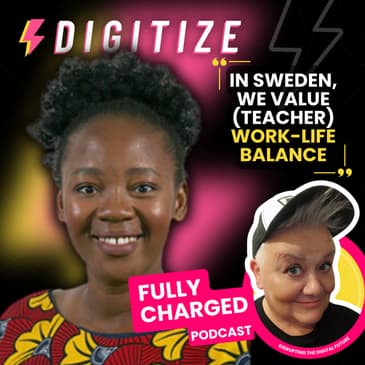
Welcome to the Digitize Fully Charged Podcast, where we energise listeners, spark inspiration, and top-up your tech-game. Today, we’re joined by the incredible Mmamotlhabi François. Mmamotlhabi is a Technology Integrator from Stockholm, Sweden, and is a massive influencer in the world of Google Certified Innovators.
We’re so excited to introduce you to our world via the Digitize Fully Charged Podcast. Each week, we’ll bring you top-tier guests, curate new and exciting tools for you to try, and answer your tech-fueled questions so that you leave feeling fully charged and ready for action.
Subscribe and turn on notifications for the show, and, if you'd like to stay up to date with shows and more, follow us on social media @DigitizeCrew and check out the wearedigitize.com website.
Mmamotlhabi: Instagram, X, LinkedIn
Digitize: Website, Instagram, Facebook, X, TikTok, LinkedIn
Podcasts: Spotify, Apple Podcasts, YouTube, Deezer
Hosted on Acast. See acast.com/privacy for more information.
[00:00:05] Welcome to the Digitize Fully Charged Podcast, where we energize learners, spark inspiration and top up your tech game.
[00:00:13] I'm your host Pam Curry and joining me as always is Niall Ridgway.
[00:00:18] Now today's show is an interview with the incredible Mammokabe Francois from Stockholm in Sweden.
[00:00:26] We're going to discuss all sorts of tech stuff.
[00:00:29] She is a technology integration specialist at a school in Stockholm.
[00:00:35] So we're going to hear all about her journey towards that and best part of this interview.
[00:00:41] I think there's going to be a story about a pupil sneaking something into school in their school bag.
[00:00:48] I've no idea what it is, but I'm quite excited to hear about it.
[00:00:51] Okay, let's dive in.
[00:00:58] So welcome everyone to the Digitize Fully Charged Podcast.
[00:01:02] My name is Pam Curry. I'm joined again, as usual, by Niall Ridgway.
[00:01:07] And we are delighted today to welcome our very special guest live from Stockholm in Sweden.
[00:01:17] Mammokabe, would you like to tell us all about you, please?
[00:01:21] Who are you? Where are you from? What's your story? Tell our audience.
[00:01:27] All right. Thank you so much, Pam. And now thanks for having me.
[00:01:30] My name is Mamokabe Francois. I'm actually South African, if you can't tell by the accent and the colourful clothes.
[00:01:38] I'm based in Stockholm, Sweden. I'm a technology integrator at Stockholm International School.
[00:01:44] I've been here for over just over eight years.
[00:01:47] Still getting used to the winters.
[00:01:49] This is something that you never get used to.
[00:01:53] Yeah, so that's me and that's what I do.
[00:01:57] So what's a technology integrator? What does that look like?
[00:02:01] It's not a role that we typically come across here in Scotland.
[00:02:05] So, yeah, tell us a bit more about that.
[00:02:07] Right. Super. Very good question.
[00:02:08] So technology integration.
[00:02:11] What I do is I support the learning.
[00:02:14] So I support students in a pedagogical way,
[00:02:16] help them discover tech tools that they can use to enhance their learning.
[00:02:21] I also support teachers, help them and upscale and teach them how to use tech in meaningful ways for student development.
[00:02:31] And I also have an opportunity to work with parents as well.
[00:02:34] So I host monthly sessions with parents just to help them navigate digital spaces,
[00:02:40] because like most parents, they do struggle with navigating platforms,
[00:02:46] navigating what their children are up to online and just empowering them,
[00:02:49] because it's so important that they are also empowered.
[00:02:52] So really, I look after our whole school community in the middle and upper school.
[00:02:57] And that's what I do.
[00:03:01] At this point, what we like to do in the podcast is kind of dive into what you were like in your younger days.
[00:03:10] And, you know, what was the little version of you all about?
[00:03:16] Right. Little version of me.
[00:03:18] Well, if I was teaching my younger version,
[00:03:23] I don't think I would be the happiest teacher.
[00:03:28] No.
[00:03:31] Younger version of me.
[00:03:33] Well,
[00:03:36] well,
[00:03:37] I was very chatty in class as my report cards love to read out and love to highlight.
[00:03:43] So I'm in a comfortable space talking and sharing because I always spoke and shared all the stories
[00:03:54] and encouraged the teacher to also share stories because that meant that they didn't check homework.
[00:03:59] Nice.
[00:04:00] Yes.
[00:04:02] No, but yes.
[00:04:03] So back growing up, I grew up in South Africa in Pretoria.
[00:04:07] I grew up post apartheid.
[00:04:09] So I went to grade one in 1995.
[00:04:12] That was the year after Nelson Mandela just became president.
[00:04:18] And they call us the Nelson Mandela generation.
[00:04:21] So it was a bit different to how my siblings also grew up,
[00:04:25] because when they were in primary school,
[00:04:27] they had to go to private school because they were not allowed to go to multiracial schools
[00:04:33] because we are black and the political climate at that time.
[00:04:38] So growing up was very interesting, exciting, lots of new things to try out and to do.
[00:04:45] My mom signed me up for absolutely every activity.
[00:04:49] I wonder why.
[00:04:52] So, yes, I was a very active child.
[00:04:55] A lot of sport, did a lot of sport.
[00:04:58] Outdoor life was the thing because of the brilliant weather.
[00:05:02] I played netball for many years from grade one until grade seven.
[00:05:09] I was always in the pool.
[00:05:12] Wasn't the best swimmer, but I was there.
[00:05:16] Swimming.
[00:05:17] I played field hockey for many years,
[00:05:21] even leading until university and coaching field hockey as a teacher in my early years.
[00:05:27] I was in the school choir.
[00:05:29] I was part of the girl guides.
[00:05:33] I was part of a lot of things, drama, pottery classes, art classes.
[00:05:41] I was busy.
[00:05:42] You were a busy child.
[00:05:45] And it must have been a time of, was it a time of optimism in South Africa?
[00:05:50] Definitely.
[00:05:51] A lot of optimism.
[00:05:52] A lot of also not knowing, you know,
[00:05:56] a lot of unknown because everything was new.
[00:05:58] Things were new.
[00:05:59] We were allowed to be in spaces that we probably didn't have the same opportunities as we did before.
[00:06:06] And I think it was also a time where my parents were also learning a lot
[00:06:09] and trying to understand and trying to figure out and navigate this new climate.
[00:06:15] We also, it was a time where we also moved into an area where technically we weren't really allowed to be living in that area.
[00:06:22] We moved to the suburbs, formerly a white area, pretty white area before 1994.
[00:06:31] So in 1992, we were the second black family in our area.
[00:06:35] So I would say this also paved the person that I am today because I was introduced to many international families
[00:06:45] and people from different places because the area that we also lived in,
[00:06:50] there were a lot of international families, a lot of diplomats living in our street,
[00:06:55] around our street embassy houses, because at that time my dad was a medical doctor.
[00:07:01] So we kind of had a sense of privilege and a sense of status.
[00:07:04] I guess that's also what gave us the opportunity to be in these kinds of spaces.
[00:07:10] And growing up, I had many friends from different places and the primary school that I went to,
[00:07:16] although it was a local primary school, it was very international, I would say.
[00:07:22] So that really paved the way to who I am today and where I am today because of the influences, the cultures,
[00:07:32] which was absolutely fantastic.
[00:07:34] So very much, I would say, third culture kid, but in their own country, if that makes sense.
[00:07:42] Yeah, yeah.
[00:07:42] Which is a bit strange and interesting, but it's, yeah, it's something like that.
[00:07:51] So have you got to travel quite a bit then with all the people that you've met?
[00:07:55] And have you been all across the world?
[00:07:57] Where's the best places you've been to?
[00:08:00] Yeah, tell us about that.
[00:08:01] Best places.
[00:08:01] Wow.
[00:08:02] Best places that I've been to, very difficult to say,
[00:08:05] but there's one place that is always in my heart and a place that I've been lucky enough to travel to twice.
[00:08:12] First, when I was in high school, we got to travel there for hockey.
[00:08:18] I played field hockey.
[00:08:19] I went to Argentina and I absolutely love that place.
[00:08:23] Tell us what you love about Argentina.
[00:08:26] The people, the vibe, the food, the music, the color, the culture, everything.
[00:08:33] Argentina has got such a special place in my heart.
[00:08:36] Wow.
[00:08:42] Places where I was determined to go back to when I finished grade 12, when I finished high school.
[00:08:48] But my mom had other plans for me.
[00:08:51] She didn't want me to go immediately then because she knew I'd probably not come back, which fair enough.
[00:08:58] I think I might have gotten lost, found myself an Argentinian partner and hey, lived salsa and asado and all of that.
[00:09:08] So, yeah, I understand.
[00:09:11] I understand where she was coming from.
[00:09:13] Argentina, definitely.
[00:09:14] Number one for me.
[00:09:16] I spent a little bit of time in New Zealand.
[00:09:18] I enjoyed it.
[00:09:20] Went to school there for a little bit.
[00:09:23] Other countries that I've loved a lot.
[00:09:26] Hmm.
[00:09:27] It's difficult.
[00:09:28] It's difficult to say.
[00:09:29] Every country is special and unique in its own way.
[00:09:33] But for me, what makes countries really awesome and cool are the people.
[00:09:39] And what we can learn from them and the cultural experiences.
[00:09:42] Any way where I can get involved with the culture, understanding how people live, seeing how people live, how people interact, how people treat each other.
[00:09:52] For me, that's always the best.
[00:09:55] Yeah.
[00:09:56] And it's something, I mean, travel is just something that just opens your mind to the fact that we're all one big world, aren't we?
[00:10:05] And it's just, it's something that you wish everyone got the opportunity to do, don't you?
[00:10:09] Yeah, 100%.
[00:10:16] Tell us about your kind of average day then.
[00:10:18] What does a day usually bring in your world?
[00:10:22] What sort of things are you doing of a day?
[00:10:25] Yeah, day to day.
[00:10:26] Well, every day is different.
[00:10:27] I don't have a set schedule.
[00:10:29] So it's really free flow in a way.
[00:10:33] Sometimes teachers book me in advance.
[00:10:36] Sometimes it can be booked 20 minutes before a lesson.
[00:10:41] Yes, 20 minutes before a lesson that's happened before.
[00:10:43] And we've made magic happen.
[00:10:45] And that has, it works.
[00:10:47] Sometimes it works.
[00:10:48] Sometimes it doesn't.
[00:10:50] And that's okay.
[00:10:51] You know, it's part of learning.
[00:10:52] So sometimes students come to me.
[00:10:55] I work in a learning commons.
[00:10:57] I work together with our librarian.
[00:10:59] And basically our tech team, that's how we do things.
[00:11:03] We also have a bit of a maker space.
[00:11:04] So teachers have the opportunity to book us for lessons if they have something interesting that they're doing in the classroom.
[00:11:11] So, for example, if a science teacher wants to look at different models, I might think about bringing some merge cubes into the lesson to give them an opportunity to see models of the human brain in different ways.
[00:11:26] And just to bring, make learning come alive.
[00:11:30] A few weeks ago, actually, it was like five minutes before the lesson.
[00:11:34] I went to an English class and the teacher wanted to bring English idioms to life for the students.
[00:11:42] Okay.
[00:11:43] So, yeah, my first thought was, okay, let's maybe give the students an opportunity to draw on Canva.
[00:11:49] But the teacher also wanted to see the students' progress and what they were doing.
[00:11:53] And then light bulb came on and our students used Chromebooks in grade six to grade 10.
[00:12:01] And we thought, oh, why not use Google Drawing?
[00:12:05] And they can also use Google Classroom.
[00:12:07] So then the teacher could have a gallery view.
[00:12:10] And our lastminute.com work, actually, it happened and it worked and was super.
[00:12:17] And the students were able to work and to see each other's drawings once the teacher showed it on the board.
[00:12:24] So, yeah, my job encompasses those kind of things.
[00:12:28] Or if there's an issue, a social issue that's happened online, digital spaces, right?
[00:12:34] These things happen.
[00:12:35] Teachers will speak to me and I will join an advisory class to talk about digital citizenship.
[00:12:42] And things like those, those are the planned kind of work things.
[00:12:47] I also, we also do Lego, Lego League.
[00:12:51] So once a week we have training sessions with our students.
[00:12:55] Sometimes students come at break times to try out different things in the different missions.
[00:13:00] So I also do a little bit of things during break times.
[00:13:04] So, yes, as I say, my everyday, day to day, I don't have an average eight to five every day.
[00:13:13] Same thing.
[00:13:14] It's always filled with different things.
[00:13:17] I have to think on my feet.
[00:13:19] Yeah, I was just going to, that's exactly the expression I was going to use.
[00:13:22] You must have to think on your feet all the time.
[00:13:26] Yeah.
[00:13:26] Do you have a go-to lesson?
[00:13:28] So a lot of the times we kind of end up in a similar position where somebody will ask us,
[00:13:34] oh, would you mind taking this class for half an hour, for 40 minutes?
[00:13:38] Do you have, for me, my go-to is Chrome Music Lab.
[00:13:42] And I'll get the students to write their names and call it Minecraft writing and get them to draw pictures and listen back.
[00:13:49] Do you have like a go-to, right, I don't know what I'm doing.
[00:13:53] Let's pull out this tool and we'll show this to students.
[00:13:56] We'll have a great lesson using this.
[00:13:58] Do you have anything like that that you have as a backup?
[00:14:01] Well, good question.
[00:14:02] So my main backups, most of the time I do drawback to digital citizenship things because I have them on hand all the time.
[00:14:12] And it's topics that we can talk to teenagers about and it's topics that are relevant to them.
[00:14:17] So we're always talking about digital citizenship.
[00:14:20] Is it okay to post?
[00:14:22] What's okay to post?
[00:14:23] What's not okay to post?
[00:14:24] And also thinking about the current AI climate as well.
[00:14:30] You know, telling them stories and real life stories.
[00:14:34] You know, students really appreciate authenticity.
[00:14:37] And if we speak to them like they know what's happening because they do know what's happening.
[00:14:42] And ask them those difficult questions and discussing dilemmas and creating spaces where they can have these kinds of conversations that are not judgmental.
[00:14:54] So for me, personally, I really like going back to talking about these kinds of things because, yeah, it's what affects them.
[00:15:02] Things, situations that happen on the playground, for example, or after school because they all have cell phones.
[00:15:08] And so just talking about what's happening, what can they do?
[00:15:13] If this happens, how can we work together to make it better?
[00:15:18] And always reminding them that, you know, they always have an opportunity to make things better.
[00:15:24] They don't have to stay in a situation where there's drama.
[00:15:26] They can walk away.
[00:15:28] So, yeah, those, I would say, would be my go to because that applies to all ages.
[00:15:35] And it doesn't matter if students have that digital competency.
[00:15:40] They can still participate in the discussions and they have their voices heard.
[00:15:46] And yeah.
[00:15:46] One of the things that we get asked quite a bit is where can we send students or teachers to find out more about online safety and digital citizenship?
[00:15:56] Do you have a website that you typically use or do you have resources that you've made yourself?
[00:16:03] Where do you kind of send people?
[00:16:05] Where do you take the basis of your lessons from?
[00:16:08] Right.
[00:16:08] So we mainly use Common Sense Media.
[00:16:12] Yeah.
[00:16:13] I send my teachers to Common Sense and I tell them that there are lessons there ready for you if you don't feel comfortable with creating your own.
[00:16:20] So I started off using a lot of Common Sense Media resources and then I branched off to creating some of my own things or tweaking and revamping.
[00:16:31] So for me, that's one of the first places I look at.
[00:16:35] Sometimes I do look at the Google one as well, but not all the time.
[00:16:42] I think for me, the Common Sense one has been easier.
[00:16:46] Tell us what people will find if they go to Common Sense Media, because actually some listeners might not be aware of the wealth of resources that are on there.
[00:16:55] Yeah.
[00:16:56] So, so many things.
[00:16:57] So you have already lesson slides that are there for you to use that you can also import to Google Classroom.
[00:17:05] There are some quizzes at the end.
[00:17:07] They're bite-sized lessons.
[00:17:08] There are longer lessons.
[00:17:09] There are videos.
[00:17:10] Those, the lessons have lesson plans.
[00:17:13] So I always used to use them when I needed sub plans.
[00:17:18] Sure.
[00:17:19] And those were easy for any substitute teacher to follow along and to deliver because I didn't feel as comfortable with asking them to deliver a digital design thinking type assignment.
[00:17:33] So the easiest for me was always the Common Sense because there was slides.
[00:17:38] There's step-by-step what to do with each slide, how to guide conversation.
[00:17:43] There's also resources for families.
[00:17:45] So you can share resources after the lesson.
[00:17:48] So the conversations continue.
[00:17:51] Resources if you are also leading parent workshops as well.
[00:17:55] Fabulous resources, resources about age restriction things because, you know, we don't always know everything.
[00:18:05] Yeah.
[00:18:05] With books and media that students and children watch.
[00:18:12] I think for me, it's been such a great tool and a great resource.
[00:18:18] Shout out to Common Sense Media.
[00:18:19] Is that, what's the web URL for Common Sense Media?
[00:18:22] Is it?
[00:18:24] CommonSenseMedia.org?
[00:18:25] CommonSenseMedia.org.
[00:18:26] CommonSenseMedia.org.
[00:18:26] CommonSenseMedia.org.
[00:18:27] And I think it has both UK and US curriculum.
[00:18:31] Ah, cool.
[00:18:32] Yeah.
[00:18:33] So definitely big, big recommendation from you there, Mal and Clavie, on that one.
[00:18:37] I suppose confidence is something that people get from just having someone else there, isn't it?
[00:18:43] That's certainly something Niall and I have found when we've been doing similar things.
[00:18:47] Just, you know, just being there and say, it's okay.
[00:18:49] It's not going to break.
[00:18:51] It's like, you know, you can't do anything wrong here.
[00:18:54] It's fine.
[00:18:54] It will still be there.
[00:18:55] Or just that kind of confidence probably is something that comes from that, isn't it?
[00:19:01] Yeah, 100%.
[00:19:02] 100%, yeah.
[00:19:03] And even if it does break, it's fine.
[00:19:05] I mean, there'd be moments where I've been presenting something and something just didn't work.
[00:19:10] And it really did not work.
[00:19:12] And it's fine.
[00:19:14] You know, we are people too.
[00:19:15] We don't know everything.
[00:19:16] We don't have all the resources on the top of our heads.
[00:19:22] And it's okay.
[00:19:22] So talking about resources, tell us about the way your school is resourced in terms of tech and devices, Wi-Fi.
[00:19:32] What's that experience like for learners and teachers?
[00:19:37] Yes.
[00:19:38] So at our school, we're very well-kitted.
[00:19:41] We could use that term.
[00:19:43] One-on-one devices for everyone.
[00:19:45] We are a preschool, so early years.
[00:19:48] So we have three-year-olds to 18-year-olds.
[00:19:51] So preschool to grade 12.
[00:19:54] I know in the younger years, they do avoid using a lot of tech with the students, which is absolutely brilliant and it's fair.
[00:20:03] Teachers, all teachers have devices.
[00:20:06] Kitchen staff have devices as well.
[00:20:08] Support staff, everyone has devices.
[00:20:12] So basically, all the classrooms have projectors.
[00:20:17] We don't have smart boards or anything like that, but we do have projectors.
[00:20:21] We do have whiteboards and so forth.
[00:20:25] But with all the things that we do have, it doesn't mean that our technology, use of technology and the way technology is implemented is the same, right?
[00:20:34] Yeah.
[00:20:35] We can have all the things, but not everyone has the right way that they are utilizing it.
[00:20:43] That's why it's important for me to be there to help and assist and to show and to share so that we can have a unified approach and people feel confident and comfortable to use all these great tools that they have at their fingertips.
[00:20:59] We also have a makerspace.
[00:21:00] We have a lot of robotics.
[00:21:01] We have a little robot as well, a social robot that we work with at times.
[00:21:07] So I think with all the things that you have, you can have so much, but if you're not using it in a meaningful way, you basically have nothing, right?
[00:21:14] Okay, we're going to have to talk more about the social robot.
[00:21:20] Yes.
[00:21:21] I should have brought said robot here.
[00:21:25] Social robot, tell us.
[00:21:27] Social robot, yes.
[00:21:28] So we have a social robot named Misty.
[00:21:32] Yes.
[00:21:34] Misty, we are learning.
[00:21:36] We are in the learning phase to program Misty to respond to speech and to things.
[00:21:45] Misty can drive around.
[00:21:47] Misty tells jokes sometimes.
[00:21:51] I love that.
[00:21:52] Misty tells jokes, yeah.
[00:21:54] So our aim is to have Misty at least help some of our students, maybe EL students, new students feel comfortable.
[00:22:03] Maybe with the younger students.
[00:22:05] If Misty can read, the younger students can read to Misty, Misty can give some feedback.
[00:22:09] We're working on it.
[00:22:11] Let's see in the next few years.
[00:22:13] Yeah.
[00:22:13] Give us some feedback.
[00:22:14] It's something we've seen a lot of.
[00:22:16] I remember being a bet quite recently, seeing a lot of robots roaming the floors of bet.
[00:22:22] So what's your Misty like?
[00:22:24] What is it?
[00:22:26] What's the size?
[00:22:28] Size?
[00:22:28] It's like, can you see?
[00:22:31] Yeah.
[00:22:31] Yeah.
[00:22:33] About a foot tall or something?
[00:22:35] No, no, no.
[00:22:36] A little.
[00:22:36] No, no, no, no.
[00:22:37] A small.
[00:22:37] Like not so big.
[00:22:38] Like I can hold Misty.
[00:22:40] In your hands?
[00:22:41] Yeah.
[00:22:41] Okay.
[00:22:41] In my arms.
[00:22:42] Yes.
[00:22:43] Sure.
[00:22:43] And is it, is it got like a, what does it look like?
[00:22:46] Is it got like a screen?
[00:22:48] Is it got a face?
[00:22:48] Yeah.
[00:22:48] A face.
[00:22:51] You know, I think I might have to send you pictures.
[00:22:53] If you look on, I think I might have pictures of Misty on my LinkedIn.
[00:22:57] Yes.
[00:22:58] Right.
[00:22:58] We'll have a look.
[00:23:00] So you can check out, maybe Misty might have a joke for you there too.
[00:23:04] Yes.
[00:23:06] I love that.
[00:23:07] So you're programming Misty yourself?
[00:23:09] I'm programming Misty, yes.
[00:23:11] I'm learning how to program Misty.
[00:23:13] I don't have a computer science background.
[00:23:16] I'm a creative, but yeah, trying my best programming Misty.
[00:23:20] What language are you using?
[00:23:22] I'm using Blockly.
[00:23:24] Blockly.
[00:23:25] Blockly.
[00:23:26] Block coding.
[00:23:27] I'm coding Misty.
[00:23:27] Misty can be coded in Blockly or in Python.
[00:23:31] Python, yeah.
[00:23:32] Currently, I'm very comfortable with block coding.
[00:23:35] So we're coding with blocks.
[00:23:39] Yeah.
[00:23:40] Misty's on my Instagram.
[00:23:42] Misty's sometimes on my LinkedIn.
[00:23:44] So if you want to check Misty out.
[00:23:46] I love that.
[00:23:47] I love that you've got a robot called Misty.
[00:23:50] That's so cool.
[00:23:51] Yeah.
[00:23:52] Can we read what?
[00:23:53] In Scotland, one-to-one devices is a very kind of topical subject.
[00:23:57] So what we've discovered in Scotland is that some local authorities, some council areas have gone and invested in their own budgets and one-to-one devices.
[00:24:08] And some of that happened like, you know, 10 years ago almost in some authorities.
[00:24:13] But then in other local authorities in Scotland, that hasn't happened.
[00:24:19] And the government did make a bit of a commitment a few years back as an election promise to kind of roll out one-to-one devices across the country.
[00:24:29] But that's not really come to fruition as yet.
[00:24:32] So I think it's something that's, it's on, it's a conversation that we have in many schools as we go across Scotland.
[00:24:40] So it just, I think, be interesting for the listeners to hear about the kind of impact that those, like, because you must have lived the journey from, you know, having the set of computers in the library or the laptops in a cupboard or on a trolley.
[00:24:56] And then transitioning into that where everyone, you mentioned the kitchen staff, everyone has a device in your school.
[00:25:04] What's the impact of that been?
[00:25:08] Well, what's the impact of that?
[00:25:10] Really good question.
[00:25:11] I think the productivity, I would say, especially with the students.
[00:25:16] The previous school that I worked at, the laptops were in those rolling box, boxes.
[00:25:24] Yeah.
[00:25:25] And we found that students weren't able to access learning when they got home.
[00:25:29] Yeah.
[00:25:30] They weren't coming to class prepared.
[00:25:32] I'm not saying that all our students come to class prepared, but I think it does help them a little bit.
[00:25:39] They are more prepared.
[00:25:41] Their communication, their collaboration is so much better than looking at previous schools that I've worked at.
[00:25:50] And they're able to access all the things that they need to be successful in those classes.
[00:25:58] So I think that it makes a big difference.
[00:26:01] And also when all our staff members have access to these things as well, they also feel a little bit more prepared.
[00:26:09] They're able to work at home if they choose to, because in Sweden we do value the whole work-life balance thing.
[00:26:17] People can work from home if they're not teaching at that time, they can continue working from home.
[00:26:23] So that also gives people that flexibility to have that opportunity to do and to prepare and to feel ready to face the day.
[00:26:33] And I guess as well with the younger ones, you've got to be careful having a Chromebook or a device going into their bag,
[00:26:39] especially if they might be bringing in small animals into school.
[00:26:45] Yes, small animals.
[00:26:47] Yes, you heard that, small animals in a bag.
[00:26:50] Yeah.
[00:26:52] Tell us about this.
[00:26:54] Right.
[00:26:55] So when I was working in South Africa, best story.
[00:27:00] In South Africa, it was the end of the school term.
[00:27:03] It was the last day of school.
[00:27:04] My classroom was in the pre-prep section.
[00:27:07] So where the preschool is, the only class, the only primary school classroom in the pre-school.
[00:27:12] So I got to meet a lot of little students walking around, always walked into my class, asked me about what's happening, what's this.
[00:27:23] I want to hear what you're doing with the big kids, what are the big kids doing.
[00:27:27] One little guy came up to me and he said to me, he's like, Miss Clubby, I have something in my bag.
[00:27:37] I was like, hmm, you have something in your bag.
[00:27:39] What do you have in your bag?
[00:27:40] Yes, yes, yes.
[00:27:41] It's a surprise.
[00:27:43] It's a secret.
[00:27:44] I'm like, what is in your bag?
[00:27:47] Did you not?
[00:27:48] This child opens his bag and I had a guinea pig, a black guinea pig looking at me.
[00:27:55] Yep.
[00:27:56] The guinea pig.
[00:27:57] Yes.
[00:27:59] I sneaked it in.
[00:28:01] Hilarious.
[00:28:01] I sneaked it in.
[00:28:04] What do you do?
[00:28:05] Sunshine, does your mom know what you have in your bag?
[00:28:07] Does your mom know that this guinea pig?
[00:28:08] Nope.
[00:28:09] I sneaked him in.
[00:28:11] Did your teacher know?
[00:28:12] Mm-mm.
[00:28:12] Teacher didn't know.
[00:28:14] This little guinea pig survived the whole day in this little, smallest little Adidas backpack.
[00:28:22] All day in a kindergarten class.
[00:28:24] I think, how old are they?
[00:28:25] They were like five, five, six, five-year-olds.
[00:28:29] Luckily, the guinea pig was set free in the little yard that we had and all the kids were playing with this guinea pig.
[00:28:36] And I asked my friend, who was his teacher, did you know about this guinea pig?
[00:28:41] And she's like, friend, I had no idea.
[00:28:43] These kids kept going to the bathroom.
[00:28:46] This mom had the backpack on his back all day.
[00:28:49] And kids were going to the bathroom with this backpack.
[00:28:53] And she couldn't believe, like, what was happening.
[00:28:55] She had no idea what was happening.
[00:28:57] She nearly took that backpack and threw it away.
[00:29:04] So I'm glad she didn't because we probably wouldn't have had a guinea pig.
[00:29:10] But, yeah, that was one of the funniest words.
[00:29:12] That's so funny.
[00:29:16] Imagine an iPad and a guinea pig.
[00:29:18] I know.
[00:29:19] I wonder how many, do you know what?
[00:29:20] I bet that's happened in other schools.
[00:29:22] I bet that can't be a unique story.
[00:29:25] Like, it's a brilliant story.
[00:29:32] So that's a great place for us to kind of start thinking about the future.
[00:29:35] Where do you see technology going in five years?
[00:29:38] You've mentioned AI and kind of Gemini and kind of previously chatting about kind of like Canva and the artwork side of things as well.
[00:29:47] Where do you see technology going in five years?
[00:29:50] Very good question.
[00:29:52] In five years time, technology, I would see us having a better understanding of AI.
[00:29:59] I think we are also going back and thinking about student well-being, right?
[00:30:07] And how these digital spaces affect our students because they're going to be future leaders.
[00:30:14] What kind of information they put out there themselves?
[00:30:16] What kind of information are we generating?
[00:30:20] Are we being cautious?
[00:30:22] Are we protecting?
[00:30:22] How are we protecting the student identity, especially also in an AI world as well?
[00:30:30] Yeah, student data.
[00:30:31] I think student data, we're going to be looking at that.
[00:30:34] I know we are looking at it quite a lot, but I think even regular, all teachers will be looking at this a lot more.
[00:30:45] Data protection, making sure that students are safe and are navigating spaces safely.
[00:30:52] And teachers are navigating these spaces in safe, responsible, critical ways.
[00:31:00] Because we are going to be seeing advances in all things AI as we currently are.
[00:31:07] Creativity.
[00:31:08] That's also changing a lot with AI generation.
[00:31:13] I think we're also going to see a lot more emphasis on and seeing more hand-created things.
[00:31:21] Or even things that are drawn using devices, but that are not AI generated.
[00:31:25] We still have a little bit of authenticity.
[00:31:30] Because, yeah, AI can generate anything.
[00:31:32] It's going to be one of the challenges, isn't it?
[00:31:34] But, I mean, is there a need, for example, online for there to be some kind of watermark that says AI generated?
[00:31:43] Because when you think about it, at the moment we're in this strange time, aren't we, where this is all new.
[00:31:49] So, therefore, we don't have the kind of legislation and policies to support that kind of stuff.
[00:31:55] But at the moment, we've got no idea if a blog post has been generated by an AI or a human being.
[00:32:01] I mean, you can kind of tell with the images at the moment.
[00:32:05] But, you know, like the video stuff as well.
[00:32:08] I mean, we've got a fake Niall.
[00:32:10] We've got an AI Niall.
[00:32:12] Have you ever seen an app called HeyGen?
[00:32:15] No, not yet.
[00:32:17] Okay, so HeyGen is an app where you have to do a kind of like trial setup, don't you, Niall?
[00:32:27] So you have to kind of speak, you have to look at your camera and read a script so that the video tracking AI gets to know you.
[00:32:35] And then basically thereafter, once you have your AI avatar of Niall made, you can then just give it a script and it'll speak the video.
[00:32:49] Like, but that is like a deep fake Niall.
[00:32:51] That's really what it is, isn't it?
[00:32:53] And it's kind of scary and I've heard that a lot of, I think I've heard globally there's a bit of a problem in secondary schools in particular with deep fake bullying happening with teenagers, which is kind of frightening.
[00:33:10] But yeah, I mean, like what do we do as a society and as a world about protecting human creativity in a world of AI generated content?
[00:33:25] What do you think about that?
[00:33:27] Yeah, but I think it also comes with like academic integrity and honesty, you know, reminding students, you know, you need to be doing things yourself.
[00:33:37] Think critically, evaluate everything.
[00:33:39] Don't just trust because it's online doesn't mean that it's real.
[00:33:43] That's why for me, digital citizenship is so important because just getting that authenticity and that human connection.
[00:33:53] AI is never going to be human.
[00:33:54] It can mimic, it can pretend, it can really help us.
[00:33:59] But with help, there are so many risks as well.
[00:34:04] And it is scary with the whole deep fakes and students lifting things or changing things.
[00:34:11] So it is, I think it would be important to have that watermark as you mentioned.
[00:34:16] Do you still have like an analog thing that you kind of, like you will never give up?
[00:34:22] So you know how some people like, I was an English teacher.
[00:34:25] I will never have a Kindle.
[00:34:27] I love paper books.
[00:34:29] I also love my paper notebook.
[00:34:32] And I know it's kind of, I find myself writing in it and I realize that I write in it and I'll probably never look at it ever again.
[00:34:40] Because then I just get a new notebook and I fill that with, but there must be something about the art of writing on paper that helps me process whatever it is I'm doing.
[00:34:49] So yeah, I think for me, I've got another friend who will, like I keep saying like you really should get a Google Calendar.
[00:34:57] Like you really should put that in Google Calendar.
[00:34:59] And she's like, no, but I love my paper diary.
[00:35:01] And I'm like, I know, but you have to like write everything down there.
[00:35:05] You'll never get reminders.
[00:35:06] And you know, you know, what's your analog thing that you'll never give up?
[00:35:11] Pam, I'm with you on that one.
[00:35:12] Notebooks.
[00:35:13] I'm the notebook hoarder.
[00:35:16] Notebook collector.
[00:35:18] Notebooks for me.
[00:35:19] Notebooks, yes.
[00:35:20] And I also, I write, I finish them.
[00:35:24] Written many books.
[00:35:26] They're sitting in my bookshelf.
[00:35:28] Yeah.
[00:35:29] Collect dust.
[00:35:30] I don't revisit them.
[00:35:32] But for me, yes, I find writing in a notebook makes it easier for me.
[00:35:37] Digital notebooks.
[00:35:38] I struggle with the organization and knowing where my notes or where my things are.
[00:35:45] So I find for me, writing, writing in a book, writing in a notebook.
[00:35:52] My bag is always heavy.
[00:35:53] I always have a mini notebook or something, paper, a makeshift notebook.
[00:36:00] But yes, I'm a notebook collector, 100%.
[00:36:04] That analog.
[00:36:05] What about you, Niall?
[00:36:07] Have you got anything analog in your world still?
[00:36:09] There's not many.
[00:36:10] You know what?
[00:36:11] I would say the dog.
[00:36:14] Oh.
[00:36:17] Because, like I go out, I tend, I used to wear headphones all the time and everywhere.
[00:36:22] And now I'm like, no headphones, just me, the dog in the woods.
[00:36:26] And yeah, so I think just that time out in the middle of nowhere, shut off from signal from my phone and everybody kind of messaging.
[00:36:35] So I think for me, that's my analog.
[00:36:37] That's your protective analog time.
[00:36:39] Yes.
[00:36:40] I love that.
[00:36:41] I think that's a question we should ask everyone, actually.
[00:36:43] What's your analog thing you won't give up?
[00:36:47] I think that's a good one.
[00:36:52] That leads us well into some final thoughts.
[00:36:55] So a few people have mentioned that there's some people in their lives that have made a massive impact,
[00:37:01] whether that's previous teachers who have made an impact on them,
[00:37:04] or whether that is famous people or people that have just made that impact on their educational lives or their digital lives.
[00:37:13] Are there any three guests or three people that you would like us to have on the podcast?
[00:37:19] They can be fictional.
[00:37:20] They can be real.
[00:37:21] They can be people that have just made that impact on your lives.
[00:37:24] Who would they be?
[00:37:26] Oh, wow.
[00:37:27] So many people have made such big impacts on my life, especially journey to finding myself as a teacher.
[00:37:35] I would say I didn't know I was ever going to be a teacher because I started off coaching sport,
[00:37:42] being involved in sport.
[00:37:43] Then teaching kind of happened.
[00:37:47] So definitely I would say one of my hockey coaches who then employed me later, Louise Garnett-Bennett.
[00:37:56] She was my phys ed teacher, physical education teacher in high school.
[00:38:01] Another dear friend of mine who passed away in 2014, Linda Dlamini.
[00:38:08] She also was a friend from hockey.
[00:38:11] She encouraged me to be part of the hockey committee.
[00:38:15] So we used to plan social events.
[00:38:18] So she really was one of the people that really influenced me and showed me that what I could do and encouraged my hockey,
[00:38:28] encouraged my teaching before I even knew I was going to be teaching.
[00:38:34] So, um, and another person that person, I would say my gran.
[00:38:41] Oh, well.
[00:38:42] Yeah.
[00:38:43] So she also such a brave and powerful woman as well.
[00:38:48] Um, she encouraged us to be strong, working, independent women.
[00:38:56] Um, she encouraged my sense of, um, travel, um, my sense of food, connecting people.
[00:39:04] She was an incredible chef, incredible cook.
[00:39:07] She was a nurse.
[00:39:08] Um, yeah, she was incredible.
[00:39:11] Really lovely, sweet, gentle.
[00:39:14] Um, I think she was always, she was much nicer to me than the other grandkids.
[00:39:20] I think so.
[00:39:22] Um, I'm named after her mother.
[00:39:23] So my first name is actually her maiden name.
[00:39:28] So her maiden name was Motlabi.
[00:39:31] So as a female, I am a Motlabi.
[00:39:34] And my second name, yes, my second name, I'm named after her mother.
[00:39:38] Her mother's name was Lanchester.
[00:39:39] So she was Lanchester Motlabi.
[00:39:41] And funny enough, she was a headmistress.
[00:39:44] Um, so education has always been.
[00:39:47] It's there.
[00:39:48] It's been there.
[00:39:49] It's been there.
[00:39:50] I just didn't know it at that time.
[00:39:52] What, what about in the world?
[00:39:54] Cause you mentioned that you're quite, well, not recently new to edtech, but when you entered
[00:40:00] the world of edtech, you said you didn't know anyone.
[00:40:03] So what about some people that you've met on your edtech journey?
[00:40:06] Um, is there anyone, any standout people there that have helped you?
[00:40:12] Many, many, many, many, um, that have helped me and that have been part of my journey and
[00:40:19] that have also promoted me and that have, um, bounced.
[00:40:24] I've bounced so many incredible ideas from them.
[00:40:27] Um, shout out to Georgina Dean.
[00:40:30] Oh yeah.
[00:40:31] Fabulous lady in edtech.
[00:40:33] Um, I am, I've learned so much from just seeing the work that she does, being in the circles
[00:40:41] that she's been in some of the stories that she shared with me, um, how to be an authentic
[00:40:47] leader.
[00:40:47] I've learned so much from her.
[00:40:48] Um, Katie Fielding, uh, she was my mentor.
[00:40:53] Absolutely incredible.
[00:40:54] Also her journey within edtech.
[00:40:57] And now, um, she's a book creator and she's doing absolutely amazing things.
[00:41:03] Um, so, so, so, so, so, so many, too many to mention, but also, um, a shout out.
[00:41:10] Andy Caffrey has given me so many opportunities as well, um, to work with them with canopy after
[00:41:18] me just being at VIA 22.
[00:41:22] Um, Kat also saw this.
[00:41:23] She's also been a great nominal person.
[00:41:27] Um, I mean, we had never met in person.
[00:41:31] The first time we met was VIA 22.
[00:41:34] Um, and as I say to you, I don't know anyone within these spaces.
[00:41:39] And just the amount of people that I can say I've met and people that have encouraged me,
[00:41:45] um, and people that have motivated me, people that have, um, mentored me, um, too, too many
[00:41:53] to mention, but also Lawrence as well.
[00:41:56] Um, just seeing the work that he does, we've had a few chats, um, here and there and finding
[00:42:02] out how I too can try to be a, um, influence, um, within the edtech space and, um, helping
[00:42:13] other people.
[00:42:14] That's also my next steps.
[00:42:16] I really want to help others and, um, pass this along.
[00:42:21] So, Malcali, if people want to find you online, where do they go?
[00:42:25] Where are you?
[00:42:26] Where do you spend your online time?
[00:42:28] My online time?
[00:42:29] Yeah.
[00:42:30] Super, super easy, simple, always at Mamotlabi.
[00:42:34] I made it easy.
[00:42:35] I don't think there's another Mamotlabi out there.
[00:42:38] Um, so at Mamotlabi on Instagram.
[00:42:43] That's new.
[00:42:44] Instagram's new.
[00:42:45] Um, on X spaces.
[00:42:47] And then Mamotlabi, I've got also named Claylani in brackets, Francois on LinkedIn as well.
[00:42:53] So if you look for Mamotlabi, I think you might.
[00:42:57] You'll find you.
[00:42:59] Okay.
[00:43:00] Well, thank you so, so much.
[00:43:02] I've loved talking to you today.
[00:43:04] It's been truly a pleasure.
[00:43:07] Yeah, it really has.
[00:43:09] And I hope this isn't the last time we catch up, but yeah, thank you so much for talking
[00:43:14] to us.
[00:43:15] Thank you so much, Pam.
[00:43:16] And thanks, Niall, as well.
[00:43:17] Um, I really appreciate the space and the opportunity.
[00:43:21] I've never been on a podcast, so this is so exciting.
[00:43:24] It's been such a nice chat.
[00:43:25] It feels like, you know, we've been chatting for such a long time and chatting with old friends.
[00:43:31] Thank you.
[00:43:36] Thanks so much for tuning in to another episode of the Digitize Fully Charged podcast.
[00:43:41] Don't forget to follow us on Instagram, Facebook, TikTok, X, all of them.
[00:43:46] YouTube.
[00:43:47] In fact, I think we're even on Snapchat.
[00:43:50] We're usually at Digitize Crew.
[00:43:53] You can also visit us at wearedigitize.com for more insights, updates, and a place to ask
[00:44:01] questions.
[00:44:01] Stay charged.
[00:44:02] We'll catch you next time.
[00:44:04] Bye.
[00:44:05] Bye.
[00:44:06] Bye.