
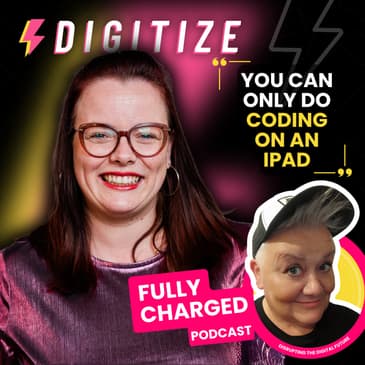
Welcome to the Digitize Fully Charged Podcast, where we energise listeners, spark inspiration, and top-up your tech-game. Today, we’re joined by the incredible Sammy White. Sammy White is a Learning Lead from Glean, winner of Tech Women 100 in 2023, and a fantastic EdTech advocate who has made waves over the past few years.
We’re so excited to introduce you to our world via the Digitize Fully Charged Podcast. Each week, we’ll bring you top-tier guests, curate new and exciting tools for you to try, and answer your tech-fueled questions so that you leave feeling fully charged and ready for action.
Subscribe and turn on notifications for the show, and, if you'd like to stay up to date with shows and more, follow us on social media @DigitizeCrew and check out the wearedigitize.com website.
Sammy White: Instagram, X, LinkedIn, A-Z of EdTech book
Digitize: Website, Instagram, Facebook, X, TikTok, LinkedIn, YouTube
Podcasts: Spotify, Apple Podcasts, YouTube, Deezer
Hosted on Acast. See acast.com/privacy for more information.
[00:00:05] Welcome to the Digitize Fully Charged Podcast, where we energise listeners, spark inspiration, a top-up tech game.
[00:00:12] I'm your host Pam Curry, I'm joined as always by Niall Ridgeway.
[00:00:17] Today's show is an interview with the incredible Sammy White, all the way from Yorkshire.
[00:00:23] We are going to discuss her journey into EdTech, her new role with the company Glean.
[00:00:30] So let's plug in, let's play, let's get started.
[00:00:38] Welcome to the Digitize Fully Charged Podcast, we're joined today by Sammy.
[00:00:44] Would you like, I'm going to hand over to you just so that you can introduce yourself, who you are, what you do, tell our listeners.
[00:00:52] Yeah, thanks for having me on. So my name is Sammy, I work for a company called Glean.
[00:00:57] We are a higher education EdTech product, but my background is I was a teacher forever.
[00:01:03] I taught GCSE maths, I was a digital lead across a large college group, and then I did some digital EdTech work.
[00:01:11] I used to work for a company called Texthelp, who make digital products as well.
[00:01:16] So I've kind of gone from the education background into fully product development and product management now,
[00:01:22] which is quite an interesting journey, I think.
[00:01:25] I'm a mum to two kids and I was named a Tech Women 100 winner last year.
[00:01:33] I know! And wasn't that amazing? How did that come about? That was incredible.
[00:01:39] Yeah, it was really special. It's an open public nomination and you get one, you get really excited.
[00:01:47] And then I got a little message to say I'd had like nine public nominations, which was really lovely.
[00:01:52] And then you submit to a panel and there's a public vote and a series of experts.
[00:01:58] But it's not just EdTech, it's like all of tech.
[00:02:00] And I think that's what made it really special to sort of recognise that I've hopefully broken out of this education, EdTech bit and gone a bit more tech focused in my career now.
[00:02:11] That's so cool. So go and tell us a little bit more about Glean, what you do, what kind of products you're working on.
[00:02:17] Yeah, so we're a higher education note taking solution.
[00:02:20] So if you struggle to take notes in long form lectures, you might use our product.
[00:02:26] We stand that we're good for learning. We know that you could just send an AI bot to your lecture and they could take the notes for you.
[00:02:33] But actually, are you learning? So we're driven by learning science.
[00:02:36] And that's my job is to make sure that everything we do is driven by learning science.
[00:02:40] So I'm responsible for checking features that are good for learning.
[00:02:44] So we do have AI, but I've made sure we've hopefully built it in a nice way.
[00:02:48] So we've built it on constructivism, learning theories and elaboration techniques and all that learning science we know from the classroom and good pedagogy.
[00:02:54] We try and build into the product.
[00:02:56] So do you get to speak to the students as well or are you more behind the computer and working from home based?
[00:03:03] Yeah, so I am behind the screen essentially.
[00:03:06] Our main market is North America.
[00:03:08] Weirdly enough, we're a Yorkshire based leads company, but our main market is North America.
[00:03:14] But we speak to students all the time and get their feedback.
[00:03:16] But yeah, my main role is to sort of sit at desk and look at features and look at plans and look at research.
[00:03:23] And how do we prove the value of what we're doing?
[00:03:25] I think we're at a real crossroads for edtech as a whole at the moment where people are going for solutions and not necessarily going for the best evidence informed solutions.
[00:03:36] And I'm really keen to sort of lead the change on that and be a bit more evidence informed.
[00:03:42] Sounds cool.
[00:03:43] What is the product?
[00:03:44] What does the product look like?
[00:03:46] Like what is it?
[00:03:48] Is that an app?
[00:03:49] Yeah, so it's an app you can have on your phone or you can have it on your laptop and it audio records the lecture.
[00:03:55] But you can mark key bits as important.
[00:03:57] So if the lecturer said you need to know this for Tuesday, you can mark it.
[00:04:00] And then when you come back to it, that little bit is highlighted.
[00:04:04] So it's just that bit.
[00:04:05] So it gives you focus on what you need to focus on.
[00:04:07] You can quiz yourself on the content.
[00:04:09] I built a quiz feature with the team.
[00:04:12] We built that with really good learning science about how we give feedback, how we give immediate feedback and why do we do delayed feedback.
[00:04:18] And it'll ask you five quick questions about the lecture so you can check if you understand it.
[00:04:22] You can link to your calendar so you can check.
[00:04:24] It can run as a Chrome extension.
[00:04:25] So if you're doing a video lecture as well.
[00:04:27] But the idea being that you are taking the notes and you're responsible for your learning.
[00:04:32] And we're just the tool that helps you do that a bit more efficiently.
[00:04:35] Wow, that sounds really cool.
[00:04:37] I'm going to check that out.
[00:04:38] Everyone check it out.
[00:04:38] What's the URL?
[00:04:40] It's glean.co and a Leeds accent doesn't really help.
[00:04:43] So it's the word clean with a G in front of it.
[00:04:45] So it's glean.co.
[00:04:47] .co.
[00:04:47] Glean.co.
[00:04:49] The Scottish accent probably doesn't help either bit.
[00:04:52] G-L-E-A-N.co.
[00:04:55] .co, yeah.
[00:05:01] So, Sammy, how did you get into, like, we talk about ourselves as, like, ed tech people.
[00:05:08] And, like, we've all got our kind of own route into that.
[00:05:11] How did you get into, like, what took you from being a maths teacher into this world that we're in?
[00:05:19] So I think the big turning point was I went on maternity leave about 10 years ago.
[00:05:24] And I came back and I had my memory stick to plug in for my year 10 lessons.
[00:05:30] And they'd blocked off the USB ports on the machines.
[00:05:34] And so I said, oh, how do I get my year 10 lessons?
[00:05:36] And the only training and advice I was given was, oh, it's all on Google now.
[00:05:42] Okay.
[00:05:42] So I literally Googled, where are my year 10 lessons?
[00:05:46] Which is hilarious now when I think about it.
[00:05:48] But I didn't know Google Drive existed.
[00:05:51] I had no idea what a cloud drive was.
[00:05:53] Because a year ago when I'd left work, it was all on a memory stick or a hard drive.
[00:05:59] Or there was a C drive or an S drive or a D drive.
[00:06:02] You know what I mean?
[00:06:02] There was a network drive.
[00:06:04] There wasn't a Google Drive or a cloud drive.
[00:06:06] And that was the level of training that I was given.
[00:06:09] And I was just told to work it out.
[00:06:11] And I remember coming home to my husband and being like, I feel like an idiot.
[00:06:14] And I hate feeling like an idiot.
[00:06:16] And I know we're skint because I've just been on maternity leave.
[00:06:18] But can I spend £129 on a Chromebook?
[00:06:21] And I'm going to teach myself how to use one of these flipping things.
[00:06:24] And I did.
[00:06:26] And within a year, I was a Google trainer.
[00:06:28] And I vowed that no one would have to feel like I felt at work.
[00:06:31] And so I became the digital lead at work to really make that change.
[00:06:36] And to make sure everyone had the support that they needed.
[00:06:39] So we were supporting 10,000 students and 1,000 staff over 20 sites.
[00:06:44] Wow.
[00:06:45] That's amazing.
[00:06:46] Yeah, including over lockdown.
[00:06:48] And I sort of just worked my way through.
[00:06:51] I became a Google trainer.
[00:06:52] I became a Google innovator in 2020 in lockdown, which was life-changing.
[00:06:59] I know Niall, you're a big fan of that program as well.
[00:07:02] And I think that sort of accelerated everything a little bit for me.
[00:07:07] But I think the main reason I ended up where I was ended up was because I never wanted anyone to feel like I felt not knowing where to find anything.
[00:07:15] And yeah, I sat with a Chromebook that was £129 and taught myself everything.
[00:07:20] That's unbelievable.
[00:07:22] And actually, do you think, like, I don't know, there's something about that kind of struggle.
[00:07:28] Like the fact that you kind of struggled and you felt what you felt.
[00:07:32] That's really powerful, isn't it?
[00:07:34] Because, like, I remember being a young English teacher and getting my first, like, higher English class.
[00:07:40] And I was like, I don't know what I'm doing.
[00:07:42] Like, how am I going to teach these 17-year-olds to be good at English when I'm just fresh out of it?
[00:07:49] And I think there's something about that.
[00:07:51] I don't know if it's imposter syndrome or whatever it is.
[00:07:53] But that panic that you feel that really makes you, like, learn it and want to, like, fully understand it so that you can teach others.
[00:08:04] You think that adds something to play in it all, eh?
[00:08:07] I definitely think so.
[00:08:09] And I think it's that care that you put into it as well because you recognise that there's a human person that you're dealing with with this ed tech struggle and, you know, supporting a thousand staff over so many sites.
[00:08:19] There were a lot of people who struggled, you know, when we had to really, you know, get down to brass tacks.
[00:08:25] I remember going for my daily walk in lockdown and having one woman on the phone to me for 15 minutes.
[00:08:30] And I'm trying to talk her through how to sign into a Google account for 15 minutes.
[00:08:33] And, you know, it's having the patience to not get frustrated at that and just be like, no, this is important to them.
[00:08:40] And this is how I'm going to help them on that journey.
[00:08:41] And it's because we've had that struggle ourselves.
[00:08:44] Yeah.
[00:08:44] The empathy.
[00:08:46] Yeah.
[00:08:46] So transitioning from that kind of lockdown and, you know, working in education, in the education context, what took you then to go to like private companies?
[00:08:57] How did that come about?
[00:08:59] Yeah.
[00:09:00] So we ended lockdown and this sort of says a lot about my personality.
[00:09:04] I was asked to go back into work and to sit and do a drop in to help people to use a tool that they'd had training on that we'd had lockdown and they'd told me they'd been using.
[00:09:15] And I was like, why, why, why am I going back?
[00:09:18] Why am I going back in?
[00:09:19] And I just quit on the spot.
[00:09:21] So I think we call it freelancing when you quit and you don't have anything to go to.
[00:09:27] I think that's what we call it.
[00:09:29] And so I quit.
[00:09:30] And I just was like, no, I'm sorry.
[00:09:31] If, if, if the lockdown wasn't going to accelerate this, what, what's it going to take to accelerate this?
[00:09:37] Just like, well, what lessons are we learning and how are we going forward?
[00:09:41] So I quit and very kindly, a Google for education partner reached out and said, how much is your mortgage payment?
[00:09:50] Let's put you on a retainer.
[00:09:52] Amazing.
[00:09:52] And that's, that's how it started.
[00:09:55] And then I delivered a national project for advanced teachers in colleges as well.
[00:10:00] And that was another big project that I did.
[00:10:03] And I did a year of saying yes to everything.
[00:10:04] So I even made images for a maths platform that people don't even know I made, but anyone who's using this maths platform, I made all the images that are inside it.
[00:10:13] And there's all sorts of bits.
[00:10:14] I wrote some bits for some textbooks and there's all sorts of things and bits and pieces that I did.
[00:10:19] So I did a year of saying yes to everything, which got me so much experience in all sorts of different bits of education and edtech mixed together.
[00:10:27] And then a couple of people asked me to write a couple of books.
[00:10:30] So I wrote a chapter in a book called Great Fe Teaching, all about how I use YouTube in the classroom.
[00:10:36] And then TextHelp came along and I went to work there for 18 months.
[00:10:40] And I know you guys know them and they're a really good bunch of people.
[00:10:43] And I had the best time working there.
[00:10:45] And that was a perfect, it was a perfect mix of education and technology for me.
[00:10:51] It was, you know, still in the sector that I know, still in maths, still in high schools, still in the bits that I know.
[00:10:58] I'm learning a bit about how edtech products work because I know how to do the delivery of them.
[00:11:03] But I didn't know how the products were built and worked.
[00:11:05] And so I learned lots there.
[00:11:06] And then a job came up at Glean and I was like, it's more local because TextHelp's a little bit of a commute.
[00:11:15] Just a little bit.
[00:11:18] TextHelp's based in Ireland, for the listeners who don't know.
[00:11:20] And I'm based in Yorkshire.
[00:11:22] So it was a flight every time I needed to go to the office.
[00:11:25] And like I said, I've got two kids.
[00:11:26] So it was getting a little bit much.
[00:11:28] And this job came up at Glean and it's really local.
[00:11:31] And it was really, it was really transformational for me because it's not my sector.
[00:11:37] Obviously, I went to university.
[00:11:38] I've been a few times, you know, just because I couldn't decide what to do.
[00:11:42] So I've just been a few times.
[00:11:45] But other than that, I don't really have that higher education experience.
[00:11:48] And so I've had to learn a lot as well.
[00:11:51] And I'm all about learning and growing.
[00:11:54] And that's been really great for me.
[00:11:55] Not only learning about the tech side of things and how we build products, but also learning more about the higher education market as well.
[00:12:08] You mentioned in there as well that you were supporting other people with books.
[00:12:12] But, I mean, we know you from outside of this podcast as well.
[00:12:16] We know that you've got your own book that you've written.
[00:12:19] Can you give us a wee bit about that?
[00:12:20] Let us know kind of what the process was for it.
[00:12:22] What was the inspiration?
[00:12:24] How did you get started?
[00:12:25] How did you get it published and shared?
[00:12:28] Just kind of what were all the processes involved?
[00:12:30] Yeah, so it's the A to Z of EdTech, which is sat over my shoulder.
[00:12:34] So it's a little, that's the actual artwork that my kids created.
[00:12:37] And I think it's really important that that's a big part of the story is that we did it as a family.
[00:12:42] And the kids created the artwork with me.
[00:12:45] And also all the funds from the book go to the local hospice where my father-in-law passed away.
[00:12:50] So I make no money off the book.
[00:12:51] It's all for the local hospice.
[00:12:53] And I think we're at like £400 now, which given how books work is actually quite cool.
[00:12:58] That's fantastic.
[00:13:00] Yeah.
[00:13:00] And so that's what the project was, was what can we do as a family?
[00:13:04] To support the hospice, but also what can we do as a family that sort of celebrates the journey we've been on as a family?
[00:13:11] Because obviously they've had to make some sacrifices when I was, you know, working all the hours in lockdown
[00:13:16] and working all the hours, you know, delivering contracts for other people when I was freelancing.
[00:13:21] So it was born out of that.
[00:13:23] And what I wanted to write was a companion for someone who is new in an ed tech role that these are all the things you have to think about that nobody really tells you you have to think about.
[00:13:33] It's not just about the tool and putting it in front of people.
[00:13:36] It's actually when you do this, this then happens.
[00:13:39] And so this happens.
[00:13:40] And then this is why you might want to think about this.
[00:13:42] And it's, it's got that in, it's got, you know, this is the things you want to think about.
[00:13:46] And then at the end of every chapter is what they call a vignette in a fancy way, but basically like an example.
[00:13:51] And it's either how I did it well or did it terribly.
[00:13:57] So the idea being, you can sort of read it and go, oh, so she knows what she's doing, but when she tried it, it didn't work out.
[00:14:04] And, oh, actually, if I did it in my setting, I'd do it this way.
[00:14:07] Because when I was supporting all those people, you know, 10,000 students and 1,000 staff over so many sites pre-lockdown,
[00:14:15] there was, there was three of us in the team.
[00:14:17] And so Steve Hope, who I think a lot of tech folks know, see, obviously learn him.
[00:14:23] So he was the boss and there was me and there was another fellow called Ian as well.
[00:14:27] And there was, that was only, that was all it was for all these people.
[00:14:30] But I started in the team under Steve before Ian came in.
[00:14:34] So for a long time, I was on my own.
[00:14:36] And then obviously I taught myself on my 129 pound Chromebook as well.
[00:14:39] And I taught myself all that.
[00:14:41] So I wanted to tell that story that when you're doing things on your own and you have to,
[00:14:45] you have to bounce ideas off people, but sometimes you don't have it.
[00:14:48] And with funding being stretched and, you know, ed tech is often,
[00:14:52] the money is on the product and not on the training.
[00:14:54] And it's on the person that has to bring that vision to life.
[00:14:57] And I really wanted to write a companion piece that would sort of help you think about those things.
[00:15:02] And I just framed it in an A to Z way.
[00:15:03] So I wrote it on my phone at night when my kids were in bed.
[00:15:08] Yeah.
[00:15:09] In my notes app on my phone.
[00:15:12] And I wrote a single note for each letter that went along.
[00:15:17] And then I put it into one big document and I sent it to a wonderful friend of mine called Dr. Lou Mycroft,
[00:15:22] who edited it for me and sort of helped me tell the story a little bit.
[00:15:25] And I think I thought editing was capitals and full stops.
[00:15:30] And it's not.
[00:15:31] It's about helping the story knit together.
[00:15:33] It's like a music producer.
[00:15:34] I describe it as like a music producer.
[00:15:35] If you ever hear the original track of something,
[00:15:38] it doesn't sound like the release single because the producer has changed it.
[00:15:42] And so that's what an editor does.
[00:15:44] And so it was really important that she did that.
[00:15:46] The opening forward is by Ivo Hanan, who's also in the ed tech space.
[00:15:49] And he was a huge supporter of me in the early days,
[00:15:52] helping me with lots of things.
[00:15:54] And he was one of those people that helped me think about things.
[00:15:57] And so that's what the book is.
[00:15:59] It's just a thinking partner for someone who is on their ed tech journey,
[00:16:03] just to think about what other types of things you want to do.
[00:16:06] But yeah, thanks for asking me about it.
[00:16:08] I forget I've written it sometimes.
[00:16:10] But yeah, that's the original artwork.
[00:16:12] And not many people get to see that.
[00:16:13] So there you go.
[00:16:14] I love that.
[00:16:14] And if people are looking to get your book,
[00:16:16] Sammy, where can they find it?
[00:16:18] So it's published on Amazon.
[00:16:19] So you can just find it on Amazon.
[00:16:21] My website is whatthetrig.co.uk.
[00:16:24] Which is the whole story in itself of where that came from in a maths CPD session.
[00:16:28] But yeah, you can just buy it on Amazon.
[00:16:30] You can buy it on Kindle as well.
[00:16:32] And any money goes to the local hospice.
[00:16:35] And yeah, if people say it's quite good, it's got good reviews.
[00:16:38] If that helps.
[00:16:40] Amazing.
[00:16:41] Amazing.
[00:16:42] So yeah, party recommendation for Sammy's book.
[00:16:45] Get it on Amazon.
[00:16:46] What the trick you need to tell us about that now?
[00:16:48] You know that.
[00:16:51] So possibly a hundred years ago.
[00:16:53] It probably wasn't.
[00:16:54] But quite a few number of years ago, we went into a CPD session.
[00:16:57] And I think maybe this is the empathy thing again of like why you learn how to do things
[00:17:01] a certain way.
[00:17:02] And we went into a CPD session about how to teach maths effectively for GCSE.
[00:17:07] And they played the Home Alone clip where he comes out of the house on their bike handlebars
[00:17:13] down the zip line into the tree house.
[00:17:16] And they paused the video and they said, wouldn't it be great now if you could make some questions
[00:17:22] up for your class on this example?
[00:17:24] Putting maths in a real life context.
[00:17:27] And I just sat there and was like, sorry, come again.
[00:17:33] And they were like, look, there's a real life example of a triangle and you could get them
[00:17:37] to do trigonometry using Home Alone as an example.
[00:17:41] And I literally sat there baffled going, how is this going to get year 10, set six to sit
[00:17:46] on their seats?
[00:17:49] Like what's going to happen?
[00:17:50] And this was back in the day of like the old GCSE grade.
[00:17:52] So this was ABCDFGs.
[00:17:54] My target was to get 100% G.
[00:17:57] So basically they had to turn up.
[00:17:59] Yeah.
[00:18:00] You know, and I sat there going, what?
[00:18:02] I'm going to play Home Alone.
[00:18:04] Are you joking me?
[00:18:05] That'll inspire them to jump out the window.
[00:18:07] What?
[00:18:07] No.
[00:18:08] And it was just this really strong example for me of how when we try to be really clever
[00:18:13] about contextualizing learning for students, we can get it really wrong.
[00:18:17] Yeah.
[00:18:17] And so that's where what the trig comes from because it was literally a trigonometry example
[00:18:22] of the triangle where I was like, what are you doing?
[00:18:24] That is not going to help my students.
[00:18:26] What the trig?
[00:18:27] Nobody's saying something else.
[00:18:29] But that's where it comes from because, you know, how often do we sit in CPD sessions
[00:18:34] and go, yeah, how long have you lived in the real world?
[00:18:36] Because that's not going to help my students.
[00:18:38] Oh, funny.
[00:18:39] Take it you never tried the lesson.
[00:18:41] I didn't, no.
[00:18:45] Funny that, isn't it?
[00:18:46] In your book, you were mentioned that it's a great place for anybody to get started and
[00:18:51] that's kind of possibly fallen into the digital lead role or somebody who's looking to get
[00:18:56] into ed tech.
[00:18:57] What's that one tool that you would recommend that they get started with?
[00:19:01] So you yourself mentioned that kind of a Chromebook was a great starting place for you.
[00:19:05] Where would you recommend these years later that somebody gets started?
[00:19:09] I still stand by Google Slides and I get that that's probably not cool.
[00:19:13] And there's probably so much of the cool tools.
[00:19:15] You could Canva it, you could do it, whatever it.
[00:19:18] And I totally get all of that.
[00:19:20] But I think if you take Google Slides as a hub of information, if you're trying to build
[00:19:25] a choose your own adventure story for creative writing, you can link to different slides
[00:19:30] quite easily.
[00:19:30] And obviously you can do this in PowerPoint, but I am a huge fan of accessibility.
[00:19:35] And when I talk about accessibility, I also include digital poverty.
[00:19:39] And I think when we're talking about devices and I understand Scotland's different to England,
[00:19:43] but in England devices, you know, parents have to purchase.
[00:19:47] And I know in some parts of Scotland they do as well.
[00:19:49] But a Chromebook is a hundred and something pounds.
[00:19:52] A laptop is, you know, significantly more than that.
[00:19:55] So I will always advocate for the things that are more accessible in different ways.
[00:20:00] But Google Slides, you can build, you can build a hub.
[00:20:04] So choose your own adventure, link to different slides.
[00:20:06] If you click this, what happens?
[00:20:07] If you click this, what happens?
[00:20:09] But then if you're doing that digital lead role, you can almost build like an app experience
[00:20:13] of like a walkthrough guide for people.
[00:20:15] So you can put the, what you started with is you put the image of the screen of the app
[00:20:19] that you're trying to guide them and a text box of what you're trying to do and then click
[00:20:24] the button.
[00:20:24] And then when they click it, it takes it to the next bit and it zooms in.
[00:20:27] And do you know what I mean?
[00:20:36] But you can get students to then create their own, create their own ideas, create their own
[00:20:40] choose your own adventures.
[00:20:41] But also from a maths point of view, it's like a evidence of a digital workbook to get
[00:20:46] them to reflect on their learning because it inserts images quite nicely.
[00:20:49] Inserting it to Google Docs and Word, I find really challenging to insert images.
[00:20:53] And obviously maths is still very handwritten and we know why.
[00:20:56] And that's not our battle.
[00:20:58] There's some things within our gift and some things not within our gift.
[00:21:00] That's not within our gift at the moment to tackle.
[00:21:02] But, you know, the power of a student snapping a quick photo of their working out, snapping
[00:21:05] it into a Google Slide, adding a text box down the side without having to worry about formatting
[00:21:09] and paragraphs and all that kind of stuff.
[00:21:11] I think those are the things that make Google Slides still a big winner for me.
[00:21:14] Yeah.
[00:21:15] Yeah.
[00:21:16] And the fact that...
[00:21:16] That was where I got started a lot of the time as well.
[00:21:19] So I would make YouTube thumbnails in Google Slides and I would just export it as an image.
[00:21:24] I've done the same where it's not kind of choose your own adventure, but we were building
[00:21:28] sprites for like coding and for making video games.
[00:21:31] And we had that similar where you would click on where you want them to go.
[00:21:34] So choose your T-shirt.
[00:21:36] So they click on the green T-shirt and that would take them to slide 52 where the sprite
[00:21:39] was wearing the green T-shirt type thing.
[00:21:41] So, yeah, I'm totally with you.
[00:21:42] I think Google Slides is a great example for that.
[00:21:45] I like changing the format, changing the size of the...
[00:21:48] Like it doesn't need to be a presentation.
[00:21:50] It can be a poster and you can publish it online.
[00:21:53] You know, yeah, I think I totally agree with Sammy.
[00:21:56] There's a lot about Google Slides that, you know, is still to be appreciated, I suppose.
[00:22:03] Cool.
[00:22:04] What's the funniest thing that's ever happened to you in that kind of...
[00:22:07] Like, have you got a funny story about...
[00:22:10] Like, I've got a story about doing training years ago when I was trying to get people...
[00:22:15] It was in the early days of Glow in Scotland, which, to be honest, at that time was like
[00:22:20] a really old version of Office 365.
[00:22:23] And it wasn't a good experience for anyone, I'm not going to lie.
[00:22:26] But what we were trying to do was get people to copy web addresses and just save them in a list.
[00:22:33] And like, so they were like, we're like, right, open your favourite website and then paste it
[00:22:38] into your Office 365 list.
[00:22:40] And then you will have a list of web resources to share with your classes.
[00:22:44] Now, in this day and age, it's not sophisticated at all.
[00:22:48] But back in that time, it was quite a powerful thing for them to learn.
[00:22:53] And like, I was...
[00:22:55] We were in the session.
[00:22:56] It was like, you know, an early morning.
[00:22:58] We'd been in for an hour or so.
[00:22:59] And this guy was like looking so frustrated.
[00:23:02] Like, so frustrated.
[00:23:04] And I'm like, are you okay?
[00:23:05] And he's like, it's just ridiculous, this whole thing, this whole activity.
[00:23:11] Just ridiculous.
[00:23:12] Like, it's taking hours.
[00:23:14] And I'm like, okay.
[00:23:15] And I thought, I need to understand what he's doing.
[00:23:18] So I watched him.
[00:23:19] And what he didn't know was that you could have more than one tab open in your browser.
[00:23:26] Oh, my God.
[00:23:27] So the poor guy was like going to BBC News or whatever to capture his URL.
[00:23:33] And then like having to log into like Glow and Office 365 again to paste it.
[00:23:38] And then he would like use that same tab to go to another website.
[00:23:41] And I'm like, oh, no, he doesn't know about tabs.
[00:23:45] So I'm like, so do you know what I mean?
[00:23:47] And you're like, it fascinated me at the time because I was like,
[00:23:51] you can't assume that people know stuff.
[00:23:55] No, and I think that's a big part of it.
[00:23:58] Mine's slightly different.
[00:24:00] But I was asked to support a more mature group of teachers,
[00:24:07] work-based learning tutors.
[00:24:08] And one lady was close to retirement,
[00:24:11] so much so that she had a calendar on the wall
[00:24:13] and she was crossing off the days.
[00:24:17] And I was asked to go in and show them Ed Puzzle.
[00:24:20] For work-based learning, videos, put quizzes into videos,
[00:24:24] save loads of time.
[00:24:25] Actually, we could probably cut half the staff.
[00:24:27] Let's be honest.
[00:24:27] That's what they were aiming for.
[00:24:28] Sammy can go deliver that training.
[00:24:30] Off you go.
[00:24:31] Walked in and she went, I tell you now, I aren't doing no digital.
[00:24:35] She said, it's all right, love.
[00:24:36] I'm not going to make you do any digital.
[00:24:37] Don't worry.
[00:24:38] And we sat down and I got the Chromebooks out.
[00:24:41] She's like, it don't work.
[00:24:42] I was like, oh, right.
[00:24:44] Have you turned it on?
[00:24:45] Yeah.
[00:24:45] I'm not an idiot.
[00:24:46] I was like, right.
[00:24:47] Okay.
[00:24:48] So what's happening?
[00:24:49] She's like, it don't work, does it?
[00:24:50] I've told them a thousand times.
[00:24:52] It don't work.
[00:24:53] And they keep telling me to do this.
[00:24:55] And I was like, right, let's just spend some time together.
[00:24:58] So we finished the session.
[00:24:59] And then I sat down with her privately afterwards.
[00:25:00] And I said, what is it?
[00:25:01] What is it I can do to help?
[00:25:03] She went, I can't use a trackpad.
[00:25:04] So they've given me this mouse.
[00:25:06] I said, right.
[00:25:07] That's amazing.
[00:25:09] That's super brilliant.
[00:25:10] That's going to help you loads.
[00:25:12] And then she went, but it don't work.
[00:25:14] I was like, all right.
[00:25:15] Nobody had showed her that you slide off the bottom and pull the USB bit out and stick it in.
[00:25:18] No.
[00:25:19] So she's trying to connect it up.
[00:25:20] And the end point of that story is like, fast forward a month till retirement.
[00:25:26] She then is now voice typing all her reports.
[00:25:30] She's voice typing a shopping list when she's in the supermarket.
[00:25:32] She's getting the students to voice type.
[00:25:35] And they had learning challenges.
[00:25:37] So they really appreciated that she taught them how to do this.
[00:25:40] She then created collaborative documents with parents of the students while they were out on work-based learning so they could all add comments to each other.
[00:25:47] And then she delayed retirement by six months.
[00:25:50] No, she did not.
[00:25:52] Because she was enjoying work so much.
[00:25:54] Oh, Sammy, that's such a beautiful story.
[00:25:57] Isn't it?
[00:25:58] It's so good.
[00:25:59] It's such a good story.
[00:26:01] Yeah.
[00:26:01] It just shows you.
[00:26:02] I mean, we've like the trackpad thing is real.
[00:26:06] Like Niall's been going around all over Scotland running the Chromebook Roadshow.
[00:26:11] And it's, I mean, I've only been at a few of them.
[00:26:14] But there was quite a lot of people didn't, they just couldn't work a trackpad.
[00:26:17] When you say to people, like, this is a focus.
[00:26:20] One of the things that we're going to learn is how to use the trackpad.
[00:26:23] And they just kind of look at you like, but everybody can do that.
[00:26:26] And like, no, they can't.
[00:26:28] No, they can't.
[00:26:28] Absolutely, no, they can't.
[00:26:29] And we break it down.
[00:26:29] Like, I find ways to kind of be like, oh, work with P1s.
[00:26:33] This is how I did it with P1s and use your cow horns for click and drag and make a thing of this is how I would teach them.
[00:26:39] But actually, what I was doing with the P1s, I'm doing with the staff as well.
[00:26:43] And I'm showing you, although I'm being like, this is how I did it.
[00:26:45] This is actually for you to know.
[00:26:48] And so, yeah, it's a massive thing for people to get to learn.
[00:26:52] And because when you're coming from your phone, which is touchscreen and you tap and you drag and to go to from mouse to phone or tablet.
[00:27:01] And then you're going to this trackpad as well.
[00:27:03] It's a totally different setup and way to learn things.
[00:27:05] So, yeah, it's definitely something that people need to be taught and learn how to use.
[00:27:09] I think so.
[00:27:10] And I think that everybody comes with a barrier.
[00:27:12] Like everybody comes with a barrier and the thing with ed tech and digital transformation is ultimately you're trying to get someone to buy into a dream that you're going to get them to change their behavior.
[00:27:22] And we know from behavior theories, getting people to change and do new habits is really, really hard.
[00:27:26] So they have to want to be successful.
[00:27:29] And if they're coming with a trackpad that doesn't work, they don't know how to use tabs or a mouse that they've not been shown how to plug in.
[00:27:36] And like, those are really minor things, but you will never be successful unless you spend the time and empathize and overcome those things with people.
[00:27:44] That's it.
[00:27:44] It's the time though, isn't it?
[00:27:46] Like, I mean, I've already picked up in the course of our conversation that things in your experience have been very similar to mine and to Niall's as well.
[00:27:54] Like, it's just not, training's not funded or supported in education.
[00:27:59] And you're like, how can this be?
[00:28:01] Like, I don't know if it was before our time.
[00:28:05] Like, you know, when the first, when those old BBC computers came into schools and stuff like back in the 80s, did they, maybe they spent a lot of money on IT training then?
[00:28:15] I don't know.
[00:28:15] But like, in some ways I'm like, why is this not being prioritized?
[00:28:20] And I think now, certainly in my kids' school, it's not prioritized.
[00:28:24] And also it's now outsourced.
[00:28:27] So now we're at a point where computing.
[00:28:31] So here's an example.
[00:28:33] My kid's mind was blown at the weekend because they could install Scratch on their Android tablet at home.
[00:28:38] We have Android tablets at home.
[00:28:40] And I said, why did you think you couldn't do it on your tablet?
[00:28:46] And they said to me, mummy, you can only do coding on an iPad.
[00:28:51] What?
[00:28:52] Because the company that teaches them computing that's outsourced by school arrives with 25 iPads once a week for two hours, teaches them tick, box done.
[00:29:03] They never revisit any of those skills ever again.
[00:29:05] They use no digital in anything else.
[00:29:07] And away it goes, tech goes away again.
[00:29:09] Hmm.
[00:29:12] That's, yeah, that's scary, isn't it?
[00:29:14] It is.
[00:29:15] And I think.
[00:29:16] So they're outsourcing the teaching of coding.
[00:29:19] Yeah.
[00:29:20] Right.
[00:29:21] That's fascinating.
[00:29:22] Yeah.
[00:29:23] And it's really common around here.
[00:29:25] It's really, really common that that's what happens.
[00:29:27] And my kids love playing with the bots and all the things like that.
[00:29:33] And they just don't get enough time to do it.
[00:29:36] So as parents, we end up paying for them to go to holiday clubs.
[00:29:39] To spend more time with them to learn how to do them so much more.
[00:29:43] But we spent a good couple of hours on Saturday playing in Scratch.
[00:29:46] It was blowing their minds that mummy could do Scratch.
[00:29:49] Yeah.
[00:29:50] Because also there's only one adult that knows how to do Scratch and that's the adult that brings the iPads in.
[00:29:55] Of course it is.
[00:29:55] It's not a teacher.
[00:29:56] Yeah.
[00:29:56] And so it's really hard, especially when you're at that younger end of primary where my youngest is.
[00:30:02] It's really hard for them to picture how digital skills fit into everything when we're teaching it in such isolated silos.
[00:30:08] Mm-hmm.
[00:30:10] And why do you think like, is it just a lack of confidence in the teachers, do you think?
[00:30:14] I think it's a lack of confidence and it's a lack of funding.
[00:30:18] Massively so.
[00:30:19] It's a massive lack of funding because I also help out at the school with their digital strategy and all this kind of stuff.
[00:30:26] And that's not funded in any way, shape or form.
[00:30:29] No.
[00:30:30] And it's blowing people's minds that they have a digital strategy because I've helped them write one and they know what they want to do.
[00:30:37] But, you know, it's so chronically underfunded that it's impossible to see the way through, if that makes sense.
[00:30:45] Mm-hmm.
[00:30:46] And my husband works for a hardware supplier, so we get hardware for them at a really affordable price.
[00:30:52] And even then, it's still such a battle to buy the most basic Chromebooks.
[00:30:58] And it's really worrying, I think, to be fair.
[00:31:02] We're quite a rural area as well.
[00:31:04] And so we have a problem with aspirations for young people to work in the big cities, to go work in Leeds.
[00:31:10] There are some kids that will never know where Leeds is and it's 10 miles, 15 miles.
[00:31:16] And they don't know that because of the rural location that we have.
[00:31:20] And so aspirations are being quite limited because of this underfunding.
[00:31:24] It's crazy, isn't it?
[00:31:25] The big change is needed, isn't it?
[00:31:32] That leads us really nicely into the future part of this, kind of chatting about education.
[00:31:38] And is there anything that you would change?
[00:31:41] Is there anything that you would enhance or offer to staff, to students?
[00:31:47] How would you go about kind of reshaping that education system?
[00:31:51] Brace yourself, guys.
[00:31:52] Go for it.
[00:31:53] I think we have a fundamental problem with accessibility.
[00:31:56] And I think what we do is we give an accommodation and then don't support that accommodation or we give an inappropriate accommodation.
[00:32:04] So let's take, say you've got dyslexia.
[00:32:08] Yeah.
[00:32:09] Are you going to sit your English exam?
[00:32:11] You know, sit your standards, sit your GCSE.
[00:32:14] And we're going to give you extra time.
[00:32:16] Because that's going to magically help you be able to do better in your exam.
[00:32:20] And it's not, is it?
[00:32:22] And actually, we know from studies that that does not help you in your exam.
[00:32:26] We know from research that giving students extra time is not going to help them do better in their exam.
[00:32:31] But that's what we give them.
[00:32:33] And then we might give them a Chromebook.
[00:32:35] But we might just give it in the run up to the exam.
[00:32:38] And we might just teach them on the laptop.
[00:32:40] I mean, I know stories even now of students sitting on desktop PCs that make the worry noise when they're turned on because they sit in the exam room and they're only allowed in them for mocks or actual exams.
[00:32:52] They get no other time to spend on those word processors.
[00:32:56] And then when we get them in there, the word processor isn't a decent word processor.
[00:33:00] It's a very basic limited word processor.
[00:33:03] Well, how's that helping?
[00:33:04] And so we're putting a digital barrier in to an accommodation that we're trying to help students do better with.
[00:33:10] And then we've got students who need to practice with this in the classroom.
[00:33:13] But then we put a big sign on the head saying, I've got additional needs.
[00:33:18] I'm the only person with a device.
[00:33:20] How does that work?
[00:33:21] And how does that work from an equitable point of view as well?
[00:33:24] And what's the criteria to get one of those?
[00:33:26] And how limiting is that for, well, I've got an additional need, but I've not got a diagnosis.
[00:33:31] So do I not get one of those devices?
[00:33:33] I don't get the big sign on my head saying I need extra help.
[00:33:36] And then we've got this whole thing about headphones.
[00:33:38] And if I'm going to give you a device and I'm going to give you it to do speech to text, text to speech,
[00:33:43] am I giving you headphones or am I going to make you play it in class really loud so everyone can hear it?
[00:33:48] And then am I going to, are you going to press play once, twice, three times, four, five, six?
[00:33:55] Or am I going to give you a human to read it because they can read really quietly and they can read it out really quietly for you.
[00:34:00] And it won't be as distracting to the rest of the class.
[00:34:04] And so we don't put the right accommodations in place.
[00:34:07] So the thing I would change is fundamentally think about how we approach teaching and learning.
[00:34:12] And I think one of the big things we can learn from America and they don't get it right.
[00:34:18] Let's not say they do.
[00:34:19] But one thing that they are getting right at the moment for me is universal design for learning.
[00:34:23] So if you're not across universal design for learning, there's a company called Cast and they do great work on it.
[00:34:28] But you can also find things in understood.org, which is probably my top website.
[00:34:34] If I was going to recommend anyone to look at accessibility, understood.org would be where I would go.
[00:34:39] And universal design for learning is giving students multiple means of representation.
[00:34:43] So I'm not just giving you a text.
[00:34:45] I might give you a podcast of the text of two people talking about the story.
[00:34:49] I might give you a YouTube video of someone acting out the story.
[00:34:53] It might be a movie clip of it or I might create an infographic to scaffold the large piece of text for you.
[00:34:59] Or absolute minimal effort.
[00:35:03] I might take the large piece of text and put some headings in it or tab it so you can navigate down the side a bit easier and break that text down and scaffold it.
[00:35:10] And then once I've given you that multiple means, I'm going to let you show me your work in a different way.
[00:35:15] So send me a voice note.
[00:35:16] Don't sit writing in cursive handwriting for ages for me.
[00:35:19] Send me a voice note telling me what you're thinking, you know, and how you would answer this question.
[00:35:24] Act it out, you mate.
[00:35:25] Do a video.
[00:35:25] Record a podcast.
[00:35:27] You know, do something creative.
[00:35:29] Draw me a picture to explain the characterization or the development of the character or, you know, the understanding of the text.
[00:35:37] Or, you know, perform a piece for me or whatever it is.
[00:35:40] And I can't tell you, when I moved to this approach in my teaching, the number of dances for angle facts, you know, angles on a straight line at up to 180 degrees, angles on a triangle at up to 180 degrees.
[00:35:52] I had like 16 year olds dancing that to me so they know how the facts work because the only way, other way of doing it is getting them to write it down.
[00:36:00] Well, they don't want to do that.
[00:36:02] And it's not accessible.
[00:36:04] And when we approach it in this way where we let people access it in different ways and show us what they know in different ways, we then lose the stigma of being identifiable as the person who needs accommodation.
[00:36:16] And we're all just included by the approach.
[00:36:18] So that's what I would change.
[00:36:20] And that's what I wish to go out there.
[00:36:22] But a big shout out to the website understood.org.
[00:36:24] Because also on there, we talked about empathy a lot in this, but you also have empathy scenarios on there.
[00:36:30] So they have a day in the life of a child with ADHD, a day in the life of a child with dyslexia.
[00:36:35] And you can really see how it just sort of happens across the day for students.
[00:36:39] And then you can sort of empathize with that and think what strategies can I put in place?
[00:36:43] Yeah.
[00:36:44] And actually, accessibility is for everyone, isn't it?
[00:36:47] Do you know what I mean?
[00:36:48] All these tools benefit all of us in some way at some point.
[00:36:52] I do a lot of work now with companies trying to be accessible in their meetings or their approaches to things.
[00:37:00] And what we often find is when we put an accommodation in of like, I don't know, giving a transcript to a meeting or sending a video or doing all that in industry.
[00:37:10] Actually, the people who use it more are the people who want it as a productivity hack.
[00:37:13] Yeah.
[00:37:14] Not the people who needed it as an accommodation.
[00:37:16] And that's really fascinating for me, because if I asked you to read now a government document of 56 pages.
[00:37:23] Sure, you'd have the time of your life.
[00:37:26] But if I had already read it and made a little summary of you, that might give you the scaffold to get going.
[00:37:32] But actually, if I'd ripped it into text to speech and downloaded it as an audio file, you could do it while you're emptying the dishwasher or walking the dog.
[00:37:40] That might help you out and be a bit more productive as well.
[00:37:43] And it's not about whether you need me to do that.
[00:37:46] It's whether that's going to help you be more productive and happy at work.
[00:37:50] And instead of looking at it as what do you need me to do to access your learning, which we absolutely have to do.
[00:37:55] We have a legal requirement to do that.
[00:37:57] But if we approach it to everyone and be like, what can I do to make this more engaging, to make this more meaningful and to make this more relevant to you?
[00:38:05] Yeah.
[00:38:06] Fascinating.
[00:38:07] Niall's got a really good example of that just from last week when he was speaking at a conference in Glasgow.
[00:38:14] And tell us what you did to prepare, Niall.
[00:38:17] Oh, yes.
[00:38:18] So I had all my notes written out.
[00:38:21] But obviously, down to Glasgow is a good three and a bit hour drive for me to the place.
[00:38:26] And I needed to learn what I needed to say.
[00:38:30] So I chucked in my notes to Notebook LM.
[00:38:33] And I created that podcast.
[00:38:36] And then I just repeated that on my way down in between other music and podcasts.
[00:38:41] And I learned what I had to say from this podcast, essentially, that had been created of my notes.
[00:38:48] And then when I went into the actual presentation, I had extra jokes that I could make and add to.
[00:38:57] I had points they'd mentioned.
[00:38:59] The universal design is something that I hadn't really come across previously.
[00:39:03] So that's what I've been looking into as well over this past week.
[00:39:07] It gave me extra talking points and learning points as well to go off and spark that inspiration as well.
[00:39:13] So, yeah, finding alternative routes to learn and to just scaffold that learning.
[00:39:22] Absolutely.
[00:39:22] Notebook LM is a big help for me.
[00:39:24] What needs to change for that to happen, though?
[00:39:27] So in Scotland, I'm pretty sure the SQA, the Scottish Qualifications Authority that run the exams,
[00:39:34] they've kind of made allowance for this different ways of showing where, you know, like creating a podcast or making a video or these kind of different ways.
[00:39:44] But the schools don't seem to be doing that because all they think of is essays, essays, essays.
[00:39:52] And you can't use computers in your exams.
[00:39:55] So the essays are handwritten.
[00:39:57] And so there is like, there's just a big disconnect, isn't there, between all the different parts of the system.
[00:40:04] Like I often think like, see if you got like a bunch of really smart people and put them in a room and said,
[00:40:09] invent a system where you prepare children for life and work.
[00:40:12] I just, I just don't think they'd come up with a system that we've got.
[00:40:17] No, no, 100% they wouldn't.
[00:40:19] And SQA have led the way on this.
[00:40:22] They're massively ahead of England.
[00:40:23] England is behind on this.
[00:40:25] But it comes back to, we fundamentally judge your success of education with what you achieve in your exams.
[00:40:33] Therefore, the exams have to be redesigned.
[00:40:34] And that's, that's, that's the bit that we need to.
[00:40:37] And then we have to translate that down into, it's like a smart target, isn't it?
[00:40:41] We've got the overall arching thinking we're aiming for, but actually the specific measurable, actionable thing that we're going to give to teachers to make changes with.
[00:40:48] We're not doing that.
[00:40:49] And we've not really thought about that yet either.
[00:40:52] And we talked about the chronic underfunding as well.
[00:40:54] And so, and teachers are so busy because they're doing amazing work.
[00:40:58] I know.
[00:40:58] How do they have time to think about all these things as well?
[00:41:01] So we're not giving everybody the best chance to be successful at this.
[00:41:04] And like you say, if we've got a group of people in the room to think about education, I don't think they come up with what we come up with.
[00:41:10] So it's all about borrowing bits from other people and helping yourselves with what you can.
[00:41:15] And my big plus would be to that understood website, because if you are trying to lead accessibility and changing your institution, your school, your college, people might be resistant.
[00:41:25] They might think it's an extra thing.
[00:41:27] It's something extra I've got to do.
[00:41:29] And I don't see why it's relevant to me.
[00:41:31] And they're not trying to be mean.
[00:41:32] They're just time poor.
[00:41:33] And actually, if we could give them some empathy scenarios of a day in their life, it just helps them realise a little bit more that every child just needs a little bit of a different approach.
[00:41:47] Sammie, talking about the future and AI.
[00:41:52] We've not really spent a lot of time talking about AI.
[00:41:54] I mean, like it seems to me that AI is reinventing itself about once every kind of six months.
[00:42:00] There's a new big update that just completely changes the game.
[00:42:03] And if I was developing an AI product or tool and, you know, it becomes out of date within a few months because of the next wave.
[00:42:12] I mean, I saw this podcast.
[00:42:14] I was listening to a podcast yesterday about agentive AI, where the AIs are actual agents.
[00:42:22] And this guy was saying, it was on Stephen Bartlett's Diary of a CEO podcast.
[00:42:28] And this guy was basically saying that agentive AI is going to mean that knowledge has a value of zero.
[00:42:36] Like zero.
[00:42:37] Because AI is like it's just compounding every single day because the knowledge it's acquiring on a sort of second by second basis is making it smarter all the time.
[00:42:50] So that's a good one for education, isn't it?
[00:42:54] Because we're still in this knowledge based system.
[00:42:57] And this is the thing.
[00:42:58] Like, I literally just had this conversation a moment ago with some colleagues.
[00:43:02] We're obviously a tech product and we have to watch AI.
[00:43:05] We have to build AI because the market expects it to be in there.
[00:43:08] But we want to do it in a way that we develop critical thinking and we don't just give it too much.
[00:43:13] You know, if you send an AI bot to your lecture and just got you the list of notes, I'm not sure what you would learn from that.
[00:43:19] I think what we have is we have like a scaffold of here's a brief outline.
[00:43:23] Now go away and add some more detail.
[00:43:25] And I'm quite confident that we've built quite a good approach there because we're helping.
[00:43:29] I think what we know as well from the literature is that typical demographics of students that are attracted to AI are just from disadvantaged backgrounds because it's a shortcut to success.
[00:43:40] But that then means that they open themselves up to risk that they might not have prepared for.
[00:43:44] And therefore we're opening a wider gap.
[00:43:47] And so I'm looking to tech products to offer safe ways to do AI in a safe way.
[00:43:54] And we might have to accept in doing that we don't go as fast as we can go for students because what's more important going as fast as AI can go or getting students to close the gap more.
[00:44:04] And that's a decision companies are going to have to make.
[00:44:07] And that's a decision that tech companies have to make of how we do that.
[00:44:10] But I think if you think about constructivism and it's, you know, crudy sense, you have to connect to prior knowledge.
[00:44:17] And that's all AI is doing.
[00:44:18] It's connecting to its prior knowledge.
[00:44:19] And then it's learning new schemas.
[00:44:21] And what we need to do is we need to teach students how to recognize that and equip them with the skills that they can articulate and judge themselves.
[00:44:31] Does this connect to my prior knowledge or do I need to develop a new schema?
[00:44:35] And I don't think unless we frame it in those terms, we're really going to make that connection for students.
[00:44:40] It's a new literacy, isn't it?
[00:44:41] It's literally a new literacy.
[00:44:43] Sammy, we could talk all day.
[00:44:46] And I know you've got to, I know you've got to get off.
[00:44:48] Thank you so much.
[00:44:49] It's been an absolute joy.
[00:44:51] We should catch up more often.
[00:44:53] Us.
[00:44:53] We should.
[00:44:54] We should.
[00:44:55] It's been really good.
[00:44:56] Thank you so, so much.
[00:45:04] Thanks for tuning in to another episode of the Digitized Fully Charged Podcast.
[00:45:08] Don't forget to follow us on all the socials.
[00:45:10] We're on Instagram, Facebook, TikTok, X.
[00:45:13] I think we're even on Snapchat.
[00:45:15] We're at Digitized Crew.
[00:45:17] You can also visit us at wearedigitized.com for more insights, updates and to tune in to all our podcast episodes.
[00:45:26] If you want to join us on the podcast, we're always looking to speak to great people like yourselves.
[00:45:32] So check out our wearedigitized.com website and the podcast page for details on how to sign up and get involved.